/ / News

Here’s my submission to the Canadian Copyright Consultation. You’ve still got time to get yours in, too.

Some industry representatives have advocated for a US-style anti-circumvention regime for Technical Protection Measured (TPMs, also called Digital Rights Management systems or DRMs). They argue that these will preserve creators’ rights. The 1998 US Digital Millennium Copyright Act and the various EUCD implementations in Europe have failed to deliver on this promise. Rather, they have tipped the balance in favour of TPM vendors at the expense of rightsholders and creators.

This is because anti-circumvention regimes that prohibit all circumvention — regardless of whether it is for a lawful purpose — give tremendous lock-in power to DRM vendors. For example, songs sold through the iTunes Store with Apple’s DRM on it could not be played on devices created by Apple’s rivals, even if the record-labels authorised listeners and device vendors to do this, because while the labels controlled the copyright in the works, this did not give them the right to unlock the DRM Apple had put on their music.

Record labels have long been concerned over the amount of control exerted by big-box retailers such as WalMart. But imagine if, in addition to having control over what inventory they carry, the big box stores also carried their books in such a way that they could only be shelved on WalMart shelves, they could only be read in WalMart lamps, running WalMart light bulbs. Imagine the lock-in to your customers and the lack of control over your destiny that you have signed up with if this is the path you pursue. Well, this is in fact what you get when you sell DRM’d eBooks or DRM’d music — in order to play back that DRM format, in order carry, manipulate or convert that DRM format, you have to license the DRM. The company that controls licensing for the DRM controls your business.

/ / News

My latest Guardian column, “Not every cloud has a silver lining,” is about the dirty secret of cloud computing: most of it is about making a buck off of you by supplying something you can do cheaply and easily for yourself.

Here’s something you won’t see mentioned, though: the main attraction of the cloud to investors and entrepreneurs is the idea of making money from you, on a recurring, perpetual basis, for something you currently get for a flat rate or for free without having to give up the money or privacy that cloud companies hope to leverage into fortunes…

Now, this makes sense for some limited applications. If you’re supplying a service to the public, having a cloud’s worth of on-demand storage and hosting is great news. Many companies, such as Twitter, have found that it’s more cost-effective to buy barrel-loads of storage, bandwidth and computation from distant hosting companies than it would be to buy their own servers and racks at a data-centre. And if you’re doing supercomputing applications, then tapping into the high-performance computing grid run by the world’s physics centres is a good trick.

But for the average punter, cloud computing is – to say the least – oversold. Network access remains slower, more expensive, and less reliable than hard drives and CPUs. Your access to the net grows more and more fraught each day, as entertainment companies, spyware creeps, botnet crooks, snooping coppers and shameless bosses arrogate to themselves the right to spy on, tamper with or terminate your access to the net.

Not every cloud has a silver lining

/ / Podcast

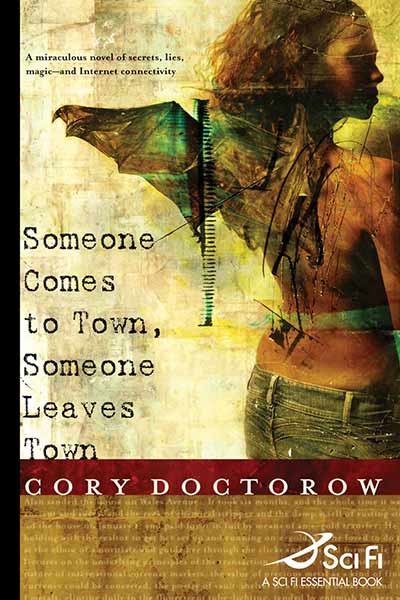
Here’s part thirty-four of my reading of my 2005 novel, Someone Comes to Town, Someone Leaves Town. Thanks to John Williams for mastering!

Mastering by John Taylor Williams: wryneckstudio@gmail.com
John Taylor Williams is a full-time self-employed audio engineer, producer, composer, and sound designer. In his free time, he makes beer, jewelry, odd musical instruments and furniture. He likes to meditate, to read and to cook.

MP3 Link

/ / News

Sejin Choi has translated my story Printcrime into Korean!

경찰들은 내가 여덟 살 때 아빠의 프린터를 박살냈다. 프린터가 뿜어내던 열기와 전자렌지에 식품 포장용 랩을 돌렸을 때 나는 것과 비슷한 그 냄새 그리고 아빠가 프린터에 신선한 찐득이를 채워 넣을 때 열중하던 모습, 프린터에서 갓 구워져 나온 물건의 감촉이 아직도 생생하다.

/ / Podcast

Here’s part thirty-three of my reading of my 2005 novel, Someone Comes to Town, Someone Leaves Town. Thanks to John Williams for mastering!

Mastering by John Taylor Williams: wryneckstudio@gmail.com
John Taylor Williams is a full-time self-employed audio engineer, producer, composer, and sound designer. In his free time, he makes beer, jewelry, odd musical instruments and furniture. He likes to meditate, to read and to cook.

MP3 Link

/ / Little Brother, News

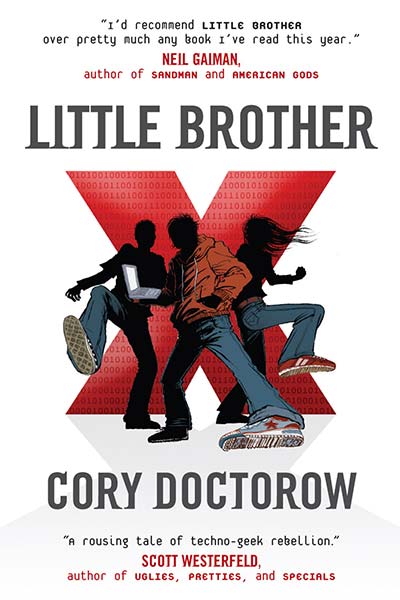
Patricia Smith is a teacher of visually impaired students in Detroit’s public school system. She mailed me a copy of my YA novel Little Brother that she had run off her school’s Braille embosser and supplied to her students. She reports, “What I could not enclose is the gratitude from my Braille reading students. For various reasons, most books in Braille are aimed at younger children. My students are all between the ages of 12 and 15 and have no real interest in reading a Kindergarten level book. I was finally able to give them something interesting, compelling, and, most importantly at their grade level.” Patricia notes that she was able to do this only because the text of the novel is available as a free, Creative Commons licensed download (though US copyright law grants her the right to prepare a Braille edition of any book, the cost of doing so from a traditional printed book is prohibitive, and converting from a DRM-crippled ebook is technically difficult).


Braille Little Brother, courtesy of Patricia Smith of the Detroit public school system, the office, Clerkenwell, London, UK

/ / News

Patricia Smith is a teacher of visually impaired students in Detroit’s public school system. She mailed me a copy of my YA novel Little Brother that she had run off her school’s Braille embosser and supplied to her students. She reports, “What I could not enclose is the gratitude from my Braille reading students. For various reasons, most books in Braille are aimed at younger children. My students are all between the ages of 12 and 15 and have no real interest in reading a Kindergarten level book. I was finally able to give them something interesting, compelling, and, most importantly at their grade level.” Patricia notes that she was able to do this only because the text of the novel is available as a free, Creative Commons licensed download (though US copyright law grants her the right to prepare a Braille edition of any book, the cost of doing so from a traditional printed book is prohibitive, and converting from a DRM-crippled ebook is technically difficult).


Braille Little Brother, courtesy of Patricia Smith of the Detroit public school system, the office, Clerkenwell, London, UK

/ / Podcast

D’oh, posted the wrong MP3 here. Fixing it now, will post to the feed in a minute or two. Sorry!

Here’s part thirty-three of my reading of my 2005 novel, Someone Comes to Town, Someone Leaves Town. Thanks to John Williams for mastering!

Mastering by John Taylor Williams: wryneckstudio@gmail.com
John Taylor Williams is a full-time self-employed audio engineer, producer, composer, and sound designer. In his free time, he makes beer, jewelry, odd musical instruments and furniture. He likes to meditate, to read and to cook.

MP3 Link