/ / Little Brother, News

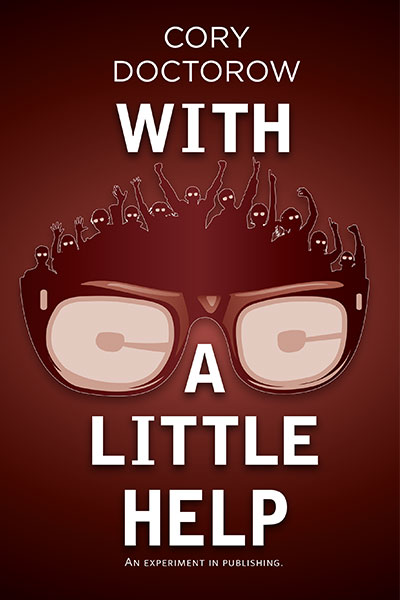
I just finished my podcast reading of my latest story, “Epoch,” which Mark Shuttleworth commissioned for my upcoming short story collection/experiment, With a Little Help. It’s the story of the sysadmin charged with shutting down the first and only functional AI, which no one can figure out a reason to save — and it’s the story of the AI’s bid to save its own life by fixing the Unix 32-bit rollover problem.

The podcast is in eight parts — I started reading it before I’d finished the story, so there’s some minor inconsistencies that’ll be fixed in the final cut. Next up I’ll be reading “Martian Chronicles,” my young adult story about free-market ideologues colonizing Mars, and the video games they play on the way to the Red Planet.


The doomed rogue AI is called BIGMAC and he is my responsibility. Not my responsibility as in “I am the creator of BIGMAC, responsible for his existence on this planet.” That honor belongs to the long-departed Dr Shannon, one of the shining lights of the once great Sun-Oracle Institute for Advanced Studies, and he had been dead for years before I even started here as a lowly sysadmin.

No, BIGMAC is my responsibility as in, “I, Odell Vyphus, am the systems administrator responsible for his care, feeding and eventual euthanizing.” Truth be told, I’d rather be Dr Shannon (except for the being dead part). I may be a lowly grunt, but I’m smart enough to know that being the Man Who Gave The World AI is better than being The Kid Who Killed It.

Not that anyone would care, really. 115 years after Mary Shelley first started humanity’s hands wringing over the possibility that we would create a machine as smart as us but out of our control, Dr Shannon did it, and it turned out to be incredibly, utterly boring. BIGMAC played chess as well as the non-self-aware computers, but he could muster some passable trash-talk while he beat you. BIGMAC could trade banalities all day long with any Turing tester who wanted to waste a day chatting with an AI. BIGMAC could solve some pretty cool vision-system problems that had eluded us for a long time, and he wasn’t a bad UI to a search engine, but the incremental benefit over non-self-aware vision systems and UIs was pretty slender. There just weren’t any killer apps for AI.

MP3s:
1,
2,
3,
4,
5,
6,
7,
8

Podcast feed

/ / Podcast

Here’s the eighth and final installment of a story-in-progress, Epoch, commissioned by Mark Shuttleworth for my forthcoming short story collection WITH A LITTLE HELP.

MP3 Link

/ / Makers, News

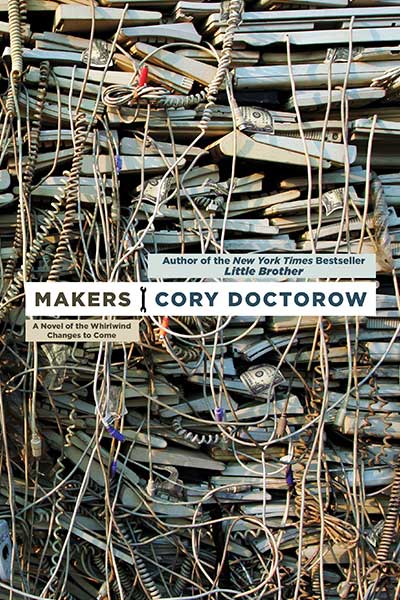
Today’s Toronto Star has a good piece about my upcoming book-launch for Makers in Toronto on Nov 12, and on the politics that informs my work.

Cory Doctorow will have mixed feelings when the news reaches him that employees of the Toronto Public Library system will not be on strike this week.

The U.K.-based author and blogger will launch his new novel, Makers, with an event Thursday at the Merril Collection of Science Fiction, Speculation and Fantasy at the Lillian H. Smith Branch on College St. Had the library been surrounded by pickets, Doctorow planned to stage the event on the sidewalk outside, with the consent of the striking workers and their union. (A tentative agreement between the library and its unionized workers was reached on Wednesday.)

“I grew up in protest politics, so doing it on the street would be really fun,” he says, during a phone interview from his London home last week. “I’ve spent enough time standing on the street with a bullhorn that it would feel very natural to me. It would be great theatre to do it on the sidewalk.”

/ / News

Today’s Toronto Star has a good piece about my upcoming book-launch for Makers in Toronto on Nov 12, and on the politics that informs my work.

Cory Doctorow will have mixed feelings when the news reaches him that employees of the Toronto Public Library system will not be on strike this week.

The U.K.-based author and blogger will launch his new novel, Makers, with an event Thursday at the Merril Collection of Science Fiction, Speculation and Fantasy at the Lillian H. Smith Branch on College St. Had the library been surrounded by pickets, Doctorow planned to stage the event on the sidewalk outside, with the consent of the striking workers and their union. (A tentative agreement between the library and its unionized workers was reached on Wednesday.)

“I grew up in protest politics, so doing it on the street would be really fun,” he says, during a phone interview from his London home last week. “I’ve spent enough time standing on the street with a bullhorn that it would feel very natural to me. It would be great theatre to do it on the sidewalk.”

/ / News

My latest Locus column, “Teen Sex,” explains why I think young adult literature should have sex — and other “mature” topics — in it.

There’s really only one question: “Why have your characters done something that is likely to upset their parents, and why don’t you punish them for doing this?”

Now, the answer.

First, because teenagers have sex and drink beer, and most of the time the worst thing that results from this is a few days of social awkwardness and a hangover, respectively. When I was a teenager, I drank sometimes. I had sex sometimes. I disobeyed authority figures sometimes.

Mostly, it was OK. Sometimes it was bad. Sometimes it was wonderful. Once or twice, it was terrible. And it was thus for everyone I knew. Teenagers take risks, even stupid risks, at times. But the chance on any given night that sneaking a beer will destroy your life is damned slim. Art isn’t exactly like life, and science fiction asks the reader to accept the impossible, but unless your book is about a universe in which disapproving parents have cooked the physics so that every act of disobedience leads swiftly to destruction, it won’t be very credible. The pathos that parents would like to see here become bathos: mawkish and
trivial, heavy-handed, and preachy.

Cory Doctorow: Teen Sex

/ / News

Tin House, a literary magazine, asked me to introduce the current science fiction issue with an overview of the field. I wrote them an essay called “Radical Presentism,” about the way that science fiction reflects the present more than the future.

Mary Shelley wasn’t worried about reanimated corpses stalking Europe, but by casting a technological innovation in the starring role of Frankenstein, she was able to tap into present-day fears about technology overpowering its masters and the hubris of the inventor. Orwell didn’t worry about a future dominated by the view-screens from 1984, he worried about a present in which technology was changing the balance of power, creating opportunities for the state to enforce its power over individuals at ever-more-granular levels.

Now, it’s true that some writers will tell you they’re extrapolating a future based on rigor and science, but they’re just wrong. Karel Čapek coined the word robotto talk about the automation and dehumanization of the workplace. Asimov’s robots were not supposed to be metaphors, but they sure acted like them, revealing the great writer’s belief in a world where careful regulation could create positive outcomes for society. (How else to explain his idea that all robots would comply with the “three laws” for thousands of years? Or, in the Foundation series, the existence of a secret society that knows exactly how to exert its leverage to steer the course of human civilization for millennia?)

For some years now, science fiction has been in the grips of a conceit called the “Singularity”—the moment at which human and machine intelligence merge, creating a break with history beyond which the future cannot be predicted, because the post-humans who live there will be utterly unrecognizable to us in their emotions and motivations. Read one way, it’s a sober prediction of the curve of history spiking infinity-ward in the near future (and many futurists will solemnly assure you that this is the case); read another way, it’s just the anxiety of a generation of winners in the technology wars, now confronted by a new generation whose fluidity with technology is so awe-inspiring that it appears we have been out-evolved by our own progeny.

CORY DOCTOROW: RADICAL PRESENTISM