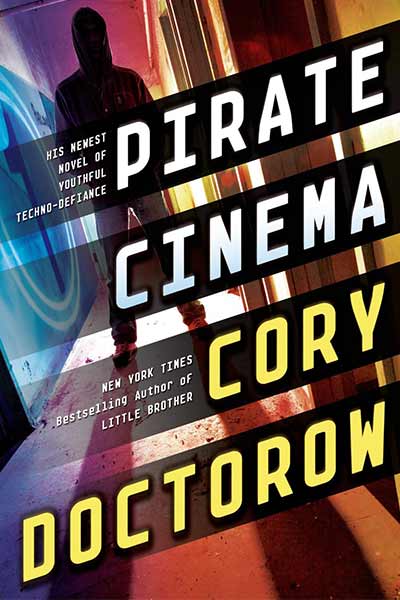
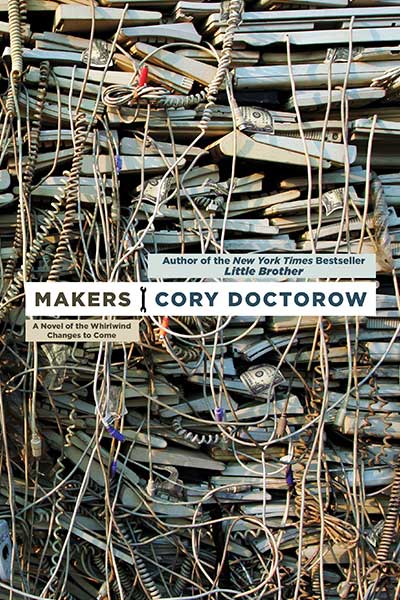
I’m delighted to announce that my novel Pirate Cinema is a finalist for this year’s Prometheus Award, given by the Libertarian Futurist Society. Winning the Prometheus for Little Brother, and being nominated again for Makers was a major honor, and I’ve got my fingers crossed for this year.
Geoffrey Cole of Prism Magazine has posted the first part of a three-part interview we conducted in Vancouver, back when I was touring with Pirate Cinema. In this part, we talk about many subjects, notably Rapture of the Nerds:
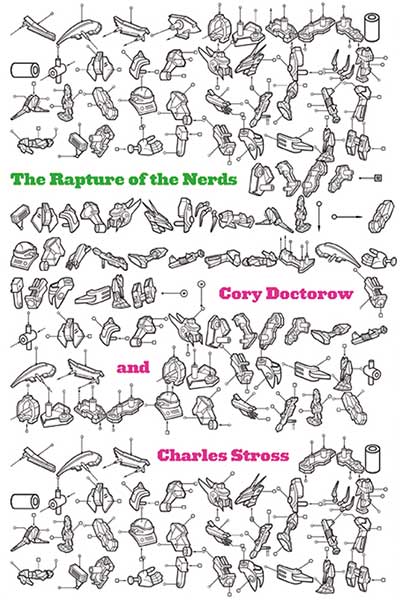
The “Rapture” in Rapture of the Nerds has many meanings. Foremost, it is the ascension of most of biological humanity to a purely digital existence. Do you really think that such a huge percentage of humanity would leave their bodies behind if they could?
Yeah, totally. The question of whether such an option will likely be available to us is something I’m not at all certain about, but in the presence of such an option, I’m very confident that large numbers of people would opt for it. We like get-evolved-quick schemes. If you can sell Thighmasters, you can sell mind uploading.
Review:
SFGate
Even if you’re a little older and a lot more jaded than the members of Doctorow’s prime target audience, “Pirate Cinema” offers plenty of rousing action and passionate debate. It’s a strong antidote to the YA market’s current glut of vampires and postapocalyptic wastelands (or vampires surviving in postapocalyptic wastelands).
Michael Berry, San Francisco Chronicle
I did an interview with The Geek’s Guide to the Galaxy, which they’ve published in both text and MP3 form. We talked about Pirate Cinema, Rapture of the Nerds, the Humble Ebook Bundle, the future of publishing, the Disney/Star Wars merger, and lots more:
Wired: Do you ever get letters from kids who have been inspired by your books to become hacker anarchists?
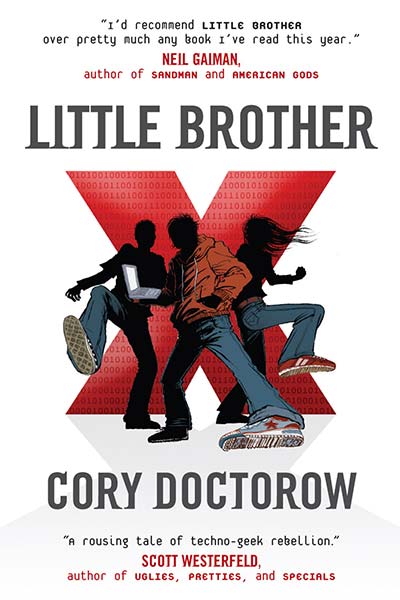
Doctorow: Yeah, all the time — at least to become hackers, and political activists. My first young-adult novel Little Brother had an afterword with a bibliography for kids who want to get involved in learning how security works, learning how computers work, learning how to program them, learning how to take them apart, learning how to solve their problems with technology as well as with politics. And the number of kids who have written to me and said that they became programmers after reading that, I couldn’t even count them. I’ve had similar responses to my second young-adult novel, For the Win, and I’ve also heard from kids who’ve read Pirate Cinema. In fact, we published an editorial by one of them on Boing Boing — an anonymous reader who makes her own movies out of Japanese anime, and who talked about what drives her and how the book resonated with her.

With Pirate Cinema, Cory Doctorow Grows His Young Hacker Army
I did an interview with The Geek’s Guide to the Galaxy, which they’ve published in both text and MP3 form. We talked about Pirate Cinema, Rapture of the Nerds, the Humble Ebook Bundle, the future of publishing, the Disney/Star Wars merger, and lots more:
Wired: Do you ever get letters from kids who have been inspired by your books to become hacker anarchists?
Doctorow: Yeah, all the time — at least to become hackers, and political activists. My first young-adult novel Little Brother had an afterword with a bibliography for kids who want to get involved in learning how security works, learning how computers work, learning how to program them, learning how to take them apart, learning how to solve their problems with technology as well as with politics. And the number of kids who have written to me and said that they became programmers after reading that, I couldn’t even count them. I’ve had similar responses to my second young-adult novel, For the Win, and I’ve also heard from kids who’ve read Pirate Cinema. In fact, we published an editorial by one of them on Boing Boing — an anonymous reader who makes her own movies out of Japanese anime, and who talked about what drives her and how the book resonated with her.
With Pirate Cinema, Cory Doctorow Grows His Young Hacker Army