Here’s the video of my Melbourne Writers’ Festival talk from last week, “Copyright vs Creativity”:
Here’s the video of my Melbourne Writers’ Festival talk from last week, “Copyright vs Creativity”:

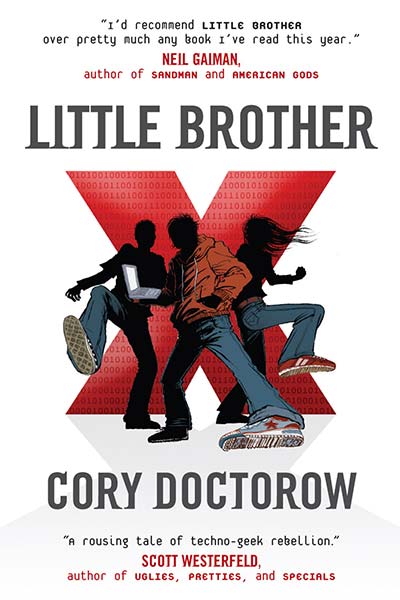
Hey, Germans! Next Monday, I leave for a ten-day tour of Deutschland with the German edition of Little Brother. At my urging, my publisher Rowohlt has set an insane pace so that I get to as many places as possible. I’m coming to Hamburg, Braunschweig, Köln, Seeheim-Jugenheim, Erding and Göttingen.
I wrap up with two days in Amsterdam, where I’m appearing at Picnic and doing an event for the Bits of Freedom activist group, in honor of the launch for the Dutch edition of Makers.
Can’t wait to see you!
Hey, Germans! Next Monday, I leave for a ten-day tour of Deutschland with the German edition of Little Brother. At my urging, my publisher Rowohlt has set an insane pace so that I get to as many places as possible. I’m coming to Hamburg, Braunschweig, Köln, Seeheim-Jugenheim, Erding and Göttingen.
I wrap up with two days in Amsterdam, where I’m appearing at Picnic and doing an event for the Bits of Freedom activist group, in honor of the launch for the Dutch edition of Makers.
Can’t wait to see you!
Hey, Germans! Next Monday, I leave for a ten-day tour of Deutschland with the German edition of Little Brother. At my urging, my publisher Rowohlt has set an insane pace so that I get to as many places as possible. I’m coming to Hamburg, Braunschweig, Köln, Seeheim-Jugenheim, Erding and Göttingen.
I wrap up with two days in Amsterdam, where I’m appearing at Picnic and doing an event for the Bits of Freedom activist group, in honor of the launch for the Dutch edition of Makers.
Can’t wait to see you!
Here’s audio from last night’s talk at the Melbourne Writers Festival: “Copyright vs Creativity.” Many thanks to
Iain H. McLean for recording and uploading this!
My latest Locus Magazine column, “Proprietary Interest,” talks about the way that our instinctive ownership claims over the stuff we find and post to the Internet do more harm than good. When we claim that public domain images, interesting links, or other net-fodder are “ours,” we invite a muddle in which others make even more compelling ownership claims. For example, if the old public-domain Lysol ad you scan is “yours,” then why shouldn’t it be Lysol’s?. This is a world in which we spend all our time arguing about whose interest is most legitimate, instead of sharing, discussing, criticizing and enjoying the world around us.
Any ethical claim to ownership over a scan of a public domain work should be treated with utmost suspicion, not least because of all the people with stronger claims than the scanner! To be consistent with the ethical principle that one should never use another’s work without permission (regardless of the law or the public domain), every scanner would have a duty to ask, at the very least, the corporations whose products are advertised in these old chestnuts (the very best of them are for brands that persist to today, since these vividly illustrate the way that our world has changed – for example, see the very frank Lysol douche ad). For if scanning a work confers an ownership interest, then surely paying for the ad’s production offers an even more compelling claim!And the publishers of the magazines and the newspapers – to scan is one thing, but what about the firm that paid to physically print the edition that we make the scan from? And then there are the copywriters and illustrators and their heirs – if scanning an ad confers a proprietary interest, then surely creating the ad should give rise to an even greater claim?
We do acknowledge these claims, at least a little. A good archivist notes the source. A good critic notes the creator. But that is the extent of the claim’s legitimacy. If we afford descendants and publishers and printers and commissioners their own little pocket of customary right-of-refusal over their works, we would eliminate the ability to keep these works alive in our culture. For these owed courtesies multiply geometrically – think of the challenge of getting all of Dickens’ or Twains’ far-flung heirs to grant permission to do anything with their ancestors’ works. What a lopsided world it would be if ten seconds’ scanner work with the public domain demanded 100 hours’ correspondence and permission-begging to be ‘‘polite!’’

Canadians: Now that summer’s over, it’s your last chance to select your favorite young adult reads in Indigo’s summerlong Teen Read Awards. They’re soliciting Canadians’ daily votes for great books for teens to read, as part of a longer and larger promotion of teen reading and literacy. I’m honored to note that my latest young adult novel For the Win is in the final heat!
Canadians: Now that summer’s over, it’s your last chance to select your favorite young adult reads in Indigo’s summerlong Teen Read Awards. They’re soliciting Canadians’ daily votes for great books for teens to read, as part of a longer and larger promotion of teen reading and literacy. I’m honored to note that my latest young adult novel For the Win is in the final heat!
I’ve just done the online checkin for my flight to Australia tomorrow for the Melbourne Writers’ Festival and the World Science Fiction Convention (also in Melbourne), so now seems like a good time to publish my schedule of appearances for the week that I’m there:
Melbourne Writers’ Festival:
Lecture, 1800h, Thursday, September 2, RMIT Capitol Theatre: Big Ideas: Copyright versus Creativity
(Note: the seminar announced for Sept 1 has been rescheduled; I’ll post here when I have the final info)
World Science Fiction Convention:
Border crossing: YA authors writing for adults and vice versa (Thursday, Sept 2, 1500h, Room 212)
Making a living: Professional writing for speculative fiction authors (Friday, Sept 3, 1200h, Room 219)
Copyright in the 21st Century (Saturday, Sept 4, 1000h, Room 203)
To market: How to sell your short stories (Saturday, Sept 4, 1100h, Room P3)
Did the future just arrive?: The e-book and the publishing industry (Saturday, Sept 4, 1300h, Room P3)
The writer and the audience: Online interaction and public personae (Saturday, Sept 4, 1500h Room 204)
Reading (Sunday, Sept 5, 1000h)
Kaffeeklatsch (Sunday, Sept 5, 1100h)
The future of short fiction (Monday, Sept 5, 1100h, Room 203
Dirty feed (Monday, Sept 5, 1200h, Room 210)