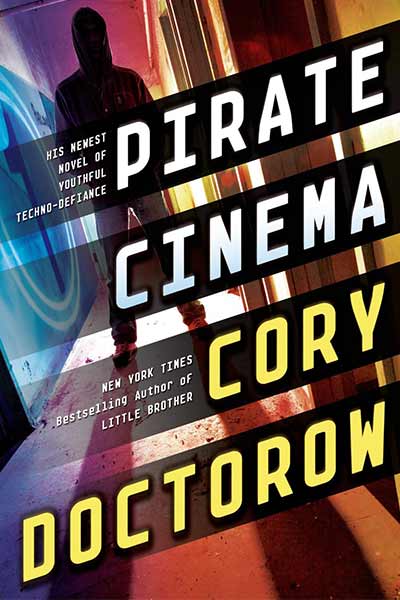
My novel Pirate Cinema is the current TechDirt Book Club selection, and we’re kicking it off today with a Google+ hangout in about five minutes. I’ve never done a Hangout before — I don’t have a G+ account because I object to its “real names” policy, but I’ve created a throwaway account for the occasion.
Live Video: Cory Doctorow Talking With Techdirt About Pirate Cinema, Copyright Law & More
IP lawyer Stuart Langley wrote a fantastic analysis of the legal issues raised in my novel Pirate Cinema a guest-article for the wonderful Law and the Multiverse site. Langley does a very thorough job of looking at the real laws and legal problems behind the plot points in the book.
The McCauley’s internet access has been disconnected consistently with what appears to be an implementation of the United Kingdom Digital Economy Act 2010. Implementation of this act has been slow, but is expected to lead to notices and service disruption as early as 2014. The implementing code of this act obligates ISPs to respond to copyright infringement reports by notice to subscribers, maintain a list of subscribers that have received notices which can be disclosed to copyright owners under court order, and degrade or deny service to repeat offenders. The technical measures imposed by the law will be appealable; on paper the appeal processes appear designed to protect subscribers, however, the regulations on the appeal process have not yet been published. This foundational scenario in Pirate Cinema is plausible.
But whether it is acceptable to cut off internet access as punishment for violating how that service is used is another question. Because of the disconnection Trent’s father cannot find work, his mother cannot find medical care, and his sister’s schooling suffers. Is internet access is a public utility that should be more difficult to disconnect than summary and unilateral administrative action? As explained in Jim Rossi’s article Universal Service in Competitive Retail Electric Power Markets: Whither the Duty to Serve? 21 Energy L.J. 27 (2000), common law principles express a public utility having a higher obligation to provide service—to provide extraordinary levels of service, especially to small residential customers. These obligations include the duty to extend service, provide continuing reliable service, provide advanced notice of disconnection and to continue service even though a customer cannot make full payment. Public utilities can have terms of service and can terminate service for violations, commonly payment and safety related transgressions. One U.S. city proposed to cut off utility service for failure to pay speeding tickets, although using utility service as a tool to enforce other regulations seems very unusual and inconsistent with the common law “duty to serve”. The question posed by Pirate Cinema is timely as governments try to regulate internet access, they do so by treating it as a public utility. This will be a double edged sword in that one treated as a utility, society should, perhaps, have a higher duty to provide internet access and similarly higher barriers before disconnecting service, including greater due process and evidentiary protections for subscribers.

A few years later, California’s economy collapses, but Marcus’s hacktivist past lands him a job as webmaster for a crusading politician who promises reform. Soon his former nemesis Masha emerges from the political underground to gift him with a thumbdrive containing a Wikileaks-style cable-dump of hard evidence of corporate and governmental perfidy.
It’s incendiary stuff—and if Masha goes missing, Marcus is supposed to release it to the world. Then Marcus sees Masha being kidnapped by the same government agents who detained and tortured Marcus years earlier.

Trent McCauley is sixteen, brilliant, and obsessed with one thing: making movies on his computer by reassembling footage from popular films he downloads from the net.
In the dystopian near-future Britain where Trent is growing up, this is more illegal than ever; the punishment for being caught three times is that your entire household’s access to the internet is cut off for a year, with no appeal.
Review:
WSJ
“Homeland” is as dead serious as “1984,” as potentially important a “novel of ideas,” with a much more engaging central character and an apparently inexhaustible supply of information on everything from brewing coffee to sneaky surveillance and how to defeat it.
Mr. Doctorow is bang up-to-date (as Orwell never was) on the uses of rapidly changing technology, both good and bad. If you want to keep up, there’s a four-page appendix on how to protect your privacy and use the Net productively—so long as you’re allowed, that is.
Tom Shippey, Wall Street Journal
Review:
Deseret News
Remains at a fast and entertaining pace until the last page
Emily Christensen, Deseret News