The Great Big Beautiful Tomorrow is SF about SF—its childish preoccupation with hardware, its retrofutures that drag on the genre like The Carousel of Progress tied to an escape zeppelin, and the immature demands for “positive” futures and happy endings. Ah, but happy endings for whom?

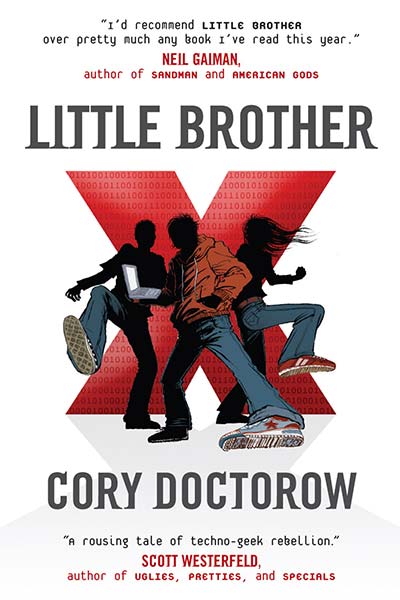
The Seattle Public Library system’s annual Summer Reading Program is called Century 22: Read the Future, and is tied in with the 50th anniversary of the Seattle World’s Fair. Young people are encouraged to scour the city’s landmarks for 1,000 books hidden throughout town, and then to re-hide them for other kids to find. Among the books in this summer’s program is my own YA novel Little Brother, which is a source of utter delight for me.

The Seattle Public Library system’s annual Summer Reading Program is called Century 22: Read the Future, and is tied in with the 50th anniversary of the Seattle World’s Fair. Young people are encouraged to scour the city’s landmarks for 1,000 books hidden throughout town, and then to re-hide them for other kids to find. Among the books in this summer’s program is my own YA novel Little Brother, which is a source of utter delight for me.
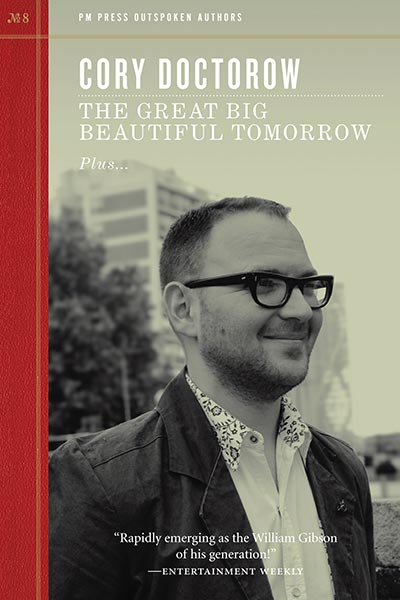
Erik Wecks has a thoughtful and smart analysis of my little book The Great Big Beautiful Tomorrow in Wired‘s GeekDad today (spoilers ahoy!)
GeekDad
What makes Doctorow’s story so unique is that in almost every science fiction story meat-space is privileged over cyber-space. The hero wins when they successfully resist technology and establish their humanity as an opposing force against the tyranny of the machine. Doctorow and other techno-positive thinkers like him argue forcefully that such thinking can only lead to dystopia and suffering. In a world of ever-quickening technological upheaval the question remains important for us: Change or Progress?
Erik Wecks has a thoughtful and smart analysis of my little book The Great Big Beautiful Tomorrow in Wired‘s GeekDad today (spoilers ahoy!)
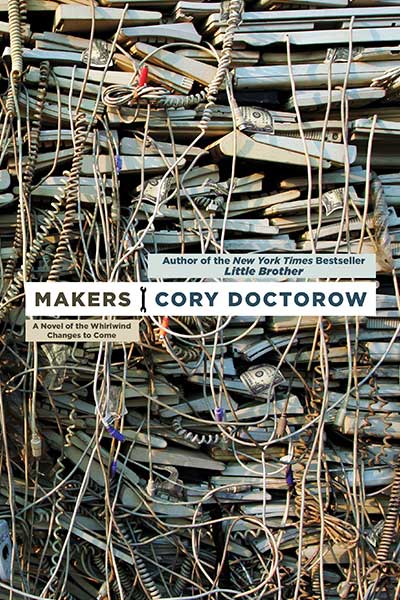
Noah Brewer just successfully defended his MA English thesis Re-Makers: The Novel in Digital Collaborative Space at the University of Georgia. As the title implies, the piece is about my novel Makers. It’s a smart piece of work, and I’m both tickled and honored.
Here’s a podcast of my last Locus column, A Prose By Any Other Name:
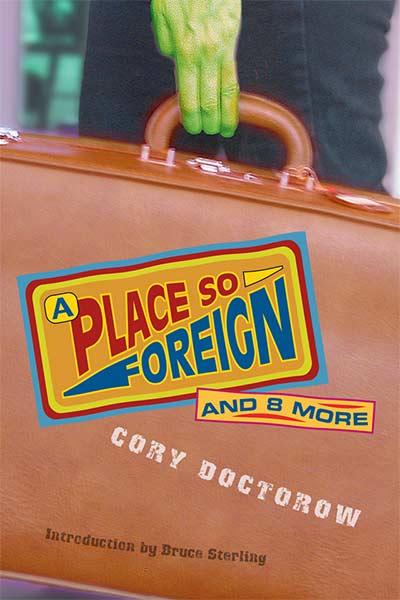
Back in 2005, I did something weird. I decided that I would embark on a project to write short stories with the same (or similar) titles to famous science fiction books and stories. My initial motivation for this was Ray Bradbury objecting to Michael Moore calling a movie Fahrenheit 9/11, which led Bradbury to call Moore an ‘‘asshole’’ and a ‘‘horrible human being’’ who’d ‘‘stolen’’ the title. Like many other writers, Bradbury has rightfully never shied from taking and adapting titles from other writers and works (‘‘I Sing the Body Electric’’, ‘‘Something Wicked This Way Comes’’, ‘‘The Women’’, etc.), and I thought that this was a silly thing for a respected writer to say. I suspected that, despite his denials, Bradbury disagreed with Moore’s politics and invented an ad hoc ethical code regarding titles to explain why what he did to Walt Whitman was fundamentally different from what Moore had done to him.
The more I thought about writing stories with ‘‘borrowed’’ titles, the more interesting it all got. Every time I thought about a famous title – one I hated, one I loved, one I had mixed feelings about – I found my subconscious simmering and then bubbling over with ideas. Stories – more so than novels – are often the product of odd subconscious associations. I’ll see something, I’ll see something else, the two will rub together, and wham, there’s a story idea crystallizing in my mind, and off I go to find a keyboard.
But for every story fragment that finds a complementary fragment to bond with and form into an idea, there are dozens of lonely haploids, grains of potential that never find another grain to join and synthesize with. Seven years into the project, the single most significant and reliable trait of ‘‘title’’ stories is that the titles exert a powerful gravity on story fragments, aggregating them into full-blown inspiration.
Mastering by John Taylor Williams: wryneckstudio@gmail.com
John Taylor Williams is a full-time self-employed audio engineer, producer, composer, and sound designer. In his free time, he makes beer, jewelry, odd musical instruments and furniture. He likes to meditate, to read and to cook.
Noah Brewer just successfully defended his MA English thesis Re-Makers: The Novel in Digital Collaborative Space at the University of Georgia. As the title implies, the piece is about my novel Makers. It’s a smart piece of work, and I’m both tickled and honored.
My latest Locus column, “A Prose By Any Other Name,” is a state-of-the-project report on my longrunning habit of writing science fiction stories with the same titles as famous books, and the interesting things I’ve discovered about creativity and my subconscious along the way.
The more I thought about writing stories with ‘‘borrowed’’ titles, the more interesting it all got. Every time I thought about a famous title – one I hated, one I loved, one I had mixed feelings about – I found my subconscious simmering and then bubbling over with ideas. Stories – more so than novels – are often the product of odd subconscious associations. I’ll see something, I’ll see something else, the two will rub together, and wham, there’s a story idea crystallizing in my mind, and off I go to find a keyboard.
But for every story fragment that finds a complementary fragment to bond with and form into an idea, there are dozens of lonely haploids, grains of potential that never find another grain to join and synthesize with. Seven years into the project, the single most significant and reliable trait of ‘‘title’’ stories is that the titles exert a powerful gravity on story fragments, aggregating them into full-blown inspiration.