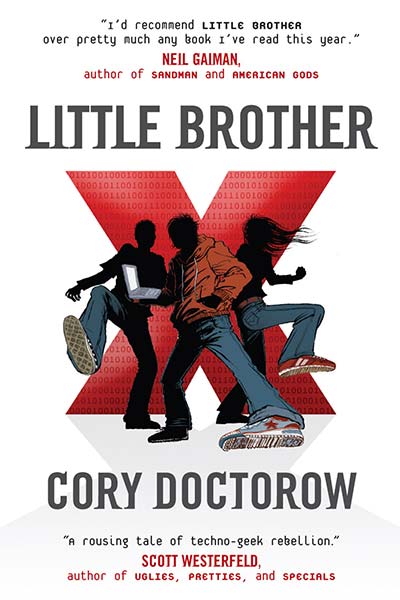
Thanks to the kind folks at Random House Audio, I’m now able to offer direct downloads of the unabridged audiobook of Little Brother, read by Kirby Heyborne. The download is DRM-free, and comes with no EULA — in other words, the only terms binding your use of it are: “Don’t violate copyright law.” It’s $20, cheap!

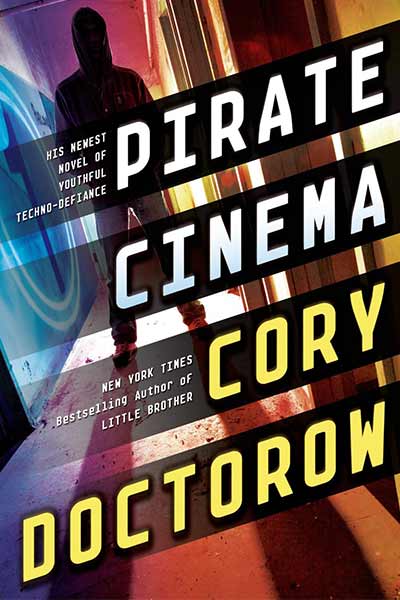
This unabridged reading of Pirate Cinema, read by Bruce Mann, is sold without DRM, or license agreement of any kind, and by buying it here, you more than triple the royalties I receive for it.
The audiobook was produced by Random House Audio. Once you’ve completed your purchase, you’ll get a download link for a collection of 128Khz MP3 files, in a ZIP archive. Simply open the archive and load into your favourite digital music player.
You’re free to do anything with this that copyright allows — play it, sing it, swing it, yodel it, I don’t give a dern (as Woody Guthrie once said!).

This unabridged reading of Little Brother, read by Kirby Heyborne, is sold without DRM, or license agreement of any kind, and by buying it here, you more than triple the royalties I receive for it.
The audiobook was produced by Random House Audio (I’ve embedded their preview below). Once you’ve completed your purchase, you’ll get a download link for a collection of 128Khz MP3 files, in a ZIP archive. Simply open the archive and load into your favourite digital music player.
You’re free to do anything with this that copyright allows — play it, sing it, swing it, yodel it, I don’t give a dern (as Woody Guthrie once said!).
Hey, Menlo Park! I’m coming to Kepler’s Books tonight at 7PM for the Pirate Cinema tour! I hope to see you there. I’ll be in San Francisco tomorrow (Thu), Berkeley on Friday, and then I head south to Pasadena and Redondo Beach, before going east to Lansing, MI, and then many other cities. Here’s the whole schedule. Be there or be unmutated!
Hey, St Louis readers! Looking forward to meeting you tonight at the first stop of my Pirate Cinema tour, at the St Louis County Library at 7PM! Next up, stops in northern and southern California, Lansing, Chicagoland, NYC, Edmonton, Vancouver, Victoria, Seattle, Toronto and Boston.
Review:
Publishers Weekly
Running away to London, Trent falls in with a group of young, high-tech squatters and anarchists who begin a David vs. Goliath war against the establishment, hoping to free the Net for creative use by the common people. Doctorow, a noted free Internet advocate (and PW columnist), handles his topic with great passion, creating engaging and believably geeky characters who share his fervor for both the Web and the new forms of art and communication it has made possible.
Review:
BN Review
Perhaps the most original theme, however, relates to the definition of creativity. Such a rethinking of this central and eternal trait of our species lies at the heart of this book, which strives to find a place in the over-regulated world for maximal expression of individual human spirit. When, midway through the book, Trent generously defines creativity in its baseline form as “doing something that isn’t obvious,” the book explodes into new philosophical realms. The outcome is less strident and melodramatic than Little Brother, more balanced and accepting of an imperfect world — while still holding aloft an idealistic torch.
Paul Di Filippo, BN Review
Review:
Booklist
It’s generally accepted that fussing with computers is a narrative buzzkill, yet Doctorow’s unrivaled verisimilitude makes every click as exciting as a band of underdog warriors storming a castle. It’s not exactly Abbie Hoffman’s Steal This Book (1971), but with its delirious insights into everything from street art to urban exploring to dumpster diving to experimental cinema, it feels damn close.
Daniel Kraus, Booklist
Review:
Kirkus
Rich characters, well-rounded — a success as a story. For computer-savvy kids who like to think.
Kirkus