/ / News, Someone Comes to Town, Someone Leaves Town

Tomorrow — Sunday — at 2PM Pacific (11AM Eastern, 10PM UK) I’m doing my in-game book-signing in Second Life, a massively multiplayer online world with an extensive toolkit for creating in-game artifacts that have sophisticated behaviors and appearances (I once met a guy who makes a real living making and selling in-game penises).

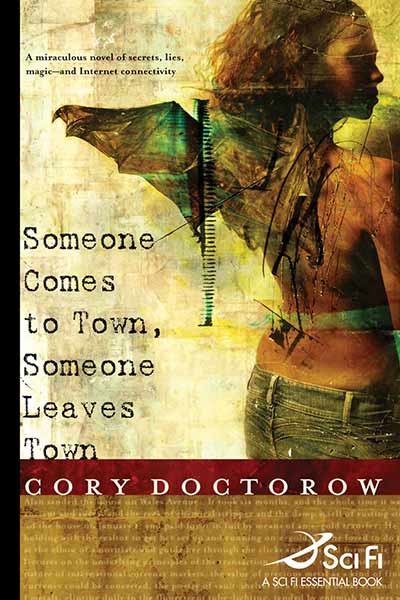
The Second Lifers made a special effort to make me welcome, holding a design competition to create an in-game edition of my new book, Someone Comes to Town, Someone Leaves Town (which included a replica cover made by creating an in-game avatar that looked like the girl on the cover’s brilliant Dave McKean painting, posing it, and taking screenshots).

They also roped a Second Lifer, lilith Pendragon, into creating a custom avatar for me that looks pretty eerily lifelike (I logged in for a bit last night and made it do funky disco moves that required a lot more coordination that the real-life me could ever muster).

Second Life’s in-game reporter, Hamlet Linden, has run a fascinating interview with lilith, who apparently has a whole in-gmae business creating custom avatars for players:


So lilith’s Cory Doctorow joins an esteemed list of her celebrity tributes which also include Frieda Kahlo and Shirley Manson of Garbage (lilith most often wears her Ms. Manson, on herself). Her Cory is so exacting, I initially assumed she’d created a custom skin of him in Photoshop. But as she tells it, she brought Doctorow into this world “just using the [default avatar creation] sliders and looking at his pic. Then I made all the clothes in Photoshop.”

She did have a challenge recreating Cory’s skull-hugging haircut, however.

“I tried to do his hair with prims to get the flat top, but it just looked horrid, and I’m not patient,” she says. “Made a hair texture for his head, similar to how I did the corn rows for Snoop, and tweaked the hair sliders to make a little stick up in front.”

(Thanks, James!)

/ / News

The BBC ran a profile of me today — a very flattering one indeed.

Author, blogger and campaigner Cory Doctorow passionately believes the internet has helped unleash a new form of creativity based around collaboration.

He co-wrote an award-winning short story, called Jury service, with a writer in Scotland called Charles Stross.

But the pair never met and instead collaborated via the internet, from start to finish.

“That story is repeated in macrocosm a million times a day on the internet,” said the Canada-born and London-based writer.

“There are people who have never met, who do not know each other, may only just pass in the night.”

But he says big media companies are trying to stifle the ability to share content in the name of protecting copyright.

/ / News, Someone Comes to Town, Someone Leaves Town

The BBC ran a profile of me today — a very flattering one indeed.

Author, blogger and campaigner Cory Doctorow passionately believes the internet has helped unleash a new form of creativity based around collaboration.

He co-wrote an award-winning short story, called Jury service, with a writer in Scotland called Charles Stross.

But the pair never met and instead collaborated via the internet, from start to finish.

“That story is repeated in macrocosm a million times a day on the internet,” said the Canada-born and London-based writer.

“There are people who have never met, who do not know each other, may only just pass in the night.”

But he says big media companies are trying to stifle the ability to share content in the name of protecting copyright.

/ / News

I was interviewed for this excellent, thoughtful article on the future of the book in USA Today.

“I think book is a verb,” Doctorow says. It’s what you’re doing when reading something like a narrative story or biography or academic argument in big chunks in multiple sessions, he says. “We need to find ways to insert the verb of book into technologies that arrive,” Doctorow adds.

Doctorow admits he hasn’t yet learned a lot from his fans about what books can become. But there are some interesting hints. For instance, he’s certain that the free electronic copies are helping increase sales of hard copy books, which is the opposite of what publishers and authors fear.

“For almost every writer, the number of sales they lose because people never hear of their book is far larger than the sales they’d lose because people can get it for free online,” Doctorow says. “The biggest threat we face isn’t piracy, it’s obscurity.”

/ / News, Someone Comes to Town, Someone Leaves Town

I was interviewed for this excellent, thoughtful article on the future of the book in USA Today.

“I think book is a verb,” Doctorow says. It’s what you’re doing when reading something like a narrative story or biography or academic argument in big chunks in multiple sessions, he says. “We need to find ways to insert the verb of book into technologies that arrive,” Doctorow adds.

Doctorow admits he hasn’t yet learned a lot from his fans about what books can become. But there are some interesting hints. For instance, he’s certain that the free electronic copies are helping increase sales of hard copy books, which is the opposite of what publishers and authors fear.

“For almost every writer, the number of sales they lose because people never hear of their book is far larger than the sales they’d lose because people can get it for free online,” Doctorow says. “The biggest threat we face isn’t piracy, it’s obscurity.”

/ / News

Next Saturday, I’m going to be speaking on a panel at the backstage.bbc.co.uk Open Tech 2005 conference in London. This is the successor to the NTK conferences like “The Festival of Inappropriate Technology” and “NotCon” — they’re always as fun as you can imagine, featuring everything from Bluetooth sniper-antennea fo synthesizers that you play by soldering and unsoldinering pins on the naked board to talks like the one I’m part of:

Where’s the British EFF?

Does the UK need a membership digital rights organisation? And if so, what cool-sounding acronyms haven’t already been taken?

Where: The Reynolds Building, St. Dunstan’s Road, Hammersmith, W6 8RP
(nearest tube stations: Hammersmith and Barons Court)

When: Saturday, 23 July, 11AM-6:45PM

£5 to attend — tickets are sold out, but cancellation tickets will be available at the door.

/ / News, Someone Comes to Town, Someone Leaves Town

A bunch of great stuff was published about my latest book over the weekend, while I was off cavorting on a birthday holiday:

  • This podcast with BlogTO.com
  • Beloved San Francisco Chronicle columnist Jon Carroll waxes rhapsodic about the book in his column
  • Estado De S. Paulo, a Brazilian daily paper, has an interview with me about my use of the Creative Commons Developing Nations license (in Portuguese)

/ / News

Today’s Wall Street Journal has an excellent piece on electronic book marketing, which talks about my experiments in making downloadable versions of my novel available.

Science-fiction novelist Cory Doctorow — whose books are published by Tor Books, an imprint of New York publisher Tom Doherty Associates LLC — has made his past two novels available as free downloads on his own Web site. His reasoning: As a relatively unknown author, he is worried more about getting readers familiar with his work than about how a free version might cut into sales. “My biggest business challenge is obscurity,” says Mr. Doctorow, who also writes for the tech-related blog Boing Boing. “The more freely my books flow, the better.”

Mr. Doctorow’s efforts have helped curry favor among his core audience of technophiles. Players of an online simulation game called Second Life have invited the author to a virtual book-signing event. They asked for Mr. Doctorow’s physical measurements and pictures of himself in his favorite clothes, which they used to design a virtual character for him. One player even created a virtual version of the book that Mr. Doctorow will be able to sign by clicking with his computer mouse. Mr. Doctorow points out that he hasn’t paid a cent for the publicity.