Indiebound list, too! Life is good where I am.
All About:
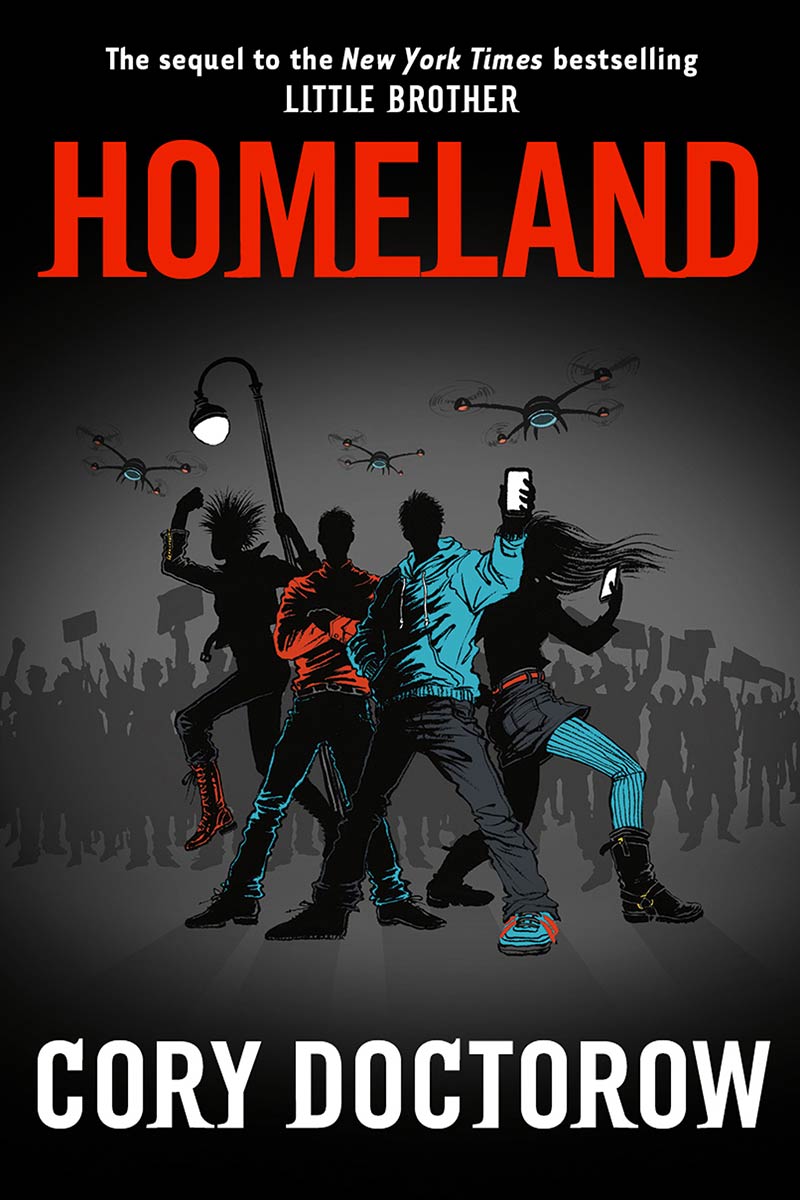
Homeland
About Reviews Buy it Download e-book Audiobook Donate a copy
Scott Sigler’s got a new YouTube show called Monstrosity, and he interviewed me (and several others!) for it. I also gave him a shakycam tour of my beloved office, which he’s posted as a bonus ep.
Review:
Deseret News
Remains at a fast and entertaining pace until the last page
Emily Christensen, Deseret News

Photographer Alex Schoenfeld came to my Homeland tour-stop at Booksmith in San Francisco and took some great shots, which he’s been kind enough to post under a Creative Commons 3.0 Non-commercial attribution only license. Thanks, Alex!
ASU’s Center for Science and the Imagination has already posted the video from this morning’s panel on hacktivism and politics. It was a good, meaty discussion: Part 1, Part 2
Last week I sat down for an interview with Rick Kleffel at KQED in San Francisco. He’s put the whole interview — a long one! — up in his Trashotron podcast feed. We talked about Homeland and other things. Rick, as always, was a very astute interviewer.
As you’ve no doubt gleaned, I’m on tour with my new novel, Homeland. A lot of people commiserate with me about the grueling pace — and it is! a new city practically every day and nowhere near enough sleep and continuous interviews and presentations from o-dark hundred to late at night — but for all that, it’s actually something I love. That’s because I get to meet readers, especially young readers (I do a lot of school presentations) and readers tell me about how my books have affected them, and it’s generally both humbling and delightful.
But every now and again, I hear from a reader whose description of her or his experience with my work leaves me, well, speechless. This is one such letter, from a young man named Brian, who emailed me this morning, and graciously gave me permission to post his letter. I’m posting it to let you know — and to remind me — that for all that touring is sometimes a lot of work, the end result is that my books end up in the hands of people for whom they can be revelatory. It’s such an awesome responsibility, and such a wonderful one. Thank you, Brian.
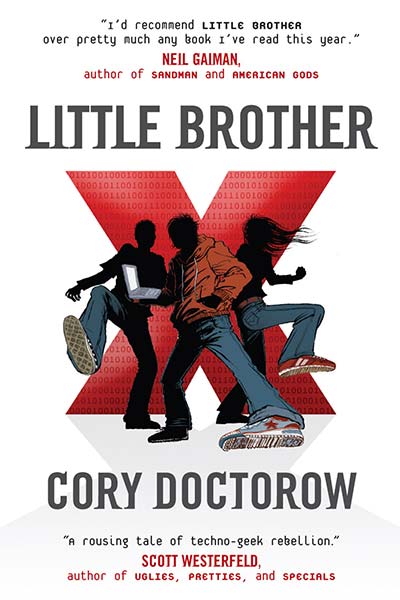
I started reading Homeland the day it came out, and finished it the day after. I had it on pre-order on my kindle, which I proceeded to bring with me everywhere for the following two days. I have read Little Brother, For The Win, Pirate Cinema, and Chicken Little. Each one amazed me (though Chicken Little is slightly less related to my point). By the time I got to the last page of Homeland, I was incensed. I didn’t have time to read the afterword, I was going to get started right away!
I looked up TrueCrypt, and was shocked to find it actually existed. Immediately downloaded. I had known about TOR before, but hadn’t thought much about it. My next move was to install it into my TC drive and begin using it. I found out about the CryptoParty movement, and I’m trying to figure out a Party in my hometown.
My point is, your book introduced me to practical cryptography and to a side of the movement for “freedom of people,” as you called it, that I had never before seen.
And then I read the afterword.
Related to my cryptography search, I had recently re-read some of the news articles and documents pertaining to Aaron’s suicide. The moment I saw his name on the afterword, I put the book down and started crying. I’m not normally a person to cry, but I couldn’t take it right then. Slowly, I picked my kindle back up and started reading again. As I read, tears welled in my eyes. I was very moved by your book, but (with all respect), these words from beyond the grave – from a real person beyond the grave – affected me more than any book ever could.
I didn’t know Aaron personally, but even so that passage made me cry. I can’t say I know how you felt, but I can say that I think it would have been hard for me to include his afterword. I’m damn grateful you chose to keep it. It is even more important now. When I read it, I was touched, but I was also pissed. My immediate, gut reaction was that no one has the right to do that to someone. The attacks and case against him were ridiculous, and I hope those who targeted him feel ashamed. My ensuing reaction was to do something, to really get out and do something. What, I’m not quite sure: I don’t know many internet activists, and my hometown isn’t exactly the center of internet activism, but that’s what the internet’s for, isn’t it? The internet lets anyone anywhere join in global movements that impassion them, and now I’m ready to join in a global initiative toward freedom on the internet across the world.
So, to summarize: your book worked. I read the Huffington Post article of an excerpt of their interview with you. Well, I am your ideal kid: I’m 14, here in 2013, and I my reaction was to “rush to a search engine and figure out proxies, free/open operating systems, freedom of information requests, local makerspaces, campaigns for political accountability…the whole package.” (Well, really I’m still working on some of those.)
Anonymous
The awesome people at Instructables have launched a series of HOWTOs based on my novel Homeland, written from the point of view of Marcus, the novel’s hero. They previously posted 11 of these for Little Brother, and the new Homeland ones should be kicking off any day. Watch this space!

In a couple of hours, I’m getting on a plane from London to Seattle to kick off the tour for Homeland, the sequel to Little Brother. My first stop is tomorrow (Feb 5) night, at the Seattle Public Library, and then I head to Portland for Feb 6, where I’ll be at Powell’s in Beaverton. Then it’s off to San Francisco, where I’ll be at Booksmith on Feb 7, and Borderlands on Feb 9.
There’s a lot more cities on this US tour, mostly in the warm spots (we’re trying to minimize weather delays, because the schedule is so tight). And though it’s not on the calendar yet, I’ll be Lawrence, KS on Feb 28 at the Kansas Union’s Alderson Auditorium at 7:30 and in Toronto on Mar 1 for a presentation at the Merril Collection at 7PM.
If you’re wondering what the book’s all about, The Oregonian ran an interview with me this weekend about the book:
A couple of years ago, it occurred to me that the emergency had become permanent. Declaring war on an abstract noun like “terror” meant that we would forever be on a war footing, where any dissent was characterized as treason, where justice was rough and unaccountable, where the relationship of the state to its citizens would grow ever more militarized.
But this permanent emergency didn’t have any visible battlefront — it was a series of largely invisible crises in the form of brutal prosecutorial overreach, police crackdowns, ubiquitous surveillance, merciless debt-hounding and repossession.
I wanted to write a story that helped kids see this invisible, all-powerful crisis unfolding around them, and helped them see that it didn’t have to be that way, that they could push back.
I’ve heard from thousands and thousands of kids who were influenced by “Little Brother,” kids for whom it was an inspiration to become makers, programmers and activists. I wanted to reach these kids again, and their little sisters and brothers, and show them that the fight goes on and it needs them.
I did a Q&A with The Oregonian to help publicize my stop at the Powell’s Books in Beaverton, OR on Feb 6 at 7PM. It’s the second stop in my 22 city tour.
What prompted you to write “Homeland,” the sequel to “Little Brother,” and what’s the impact of “Little Brother” been, especially among younger readers?
A couple of years ago, it occurred to me that the emergency had become permanent. Declaring war on an abstract noun like “terror” meant that we would forever be on a war footing, where any dissent was characterized as treason, where justice was rough and unaccountable, where the relationship of the state to its citizens would grow ever more militarized.
But this permanent emergency didn’t have any visible battlefront — it was a series of largely invisible crises in the form of brutal prosecutorial overreach, police crackdowns, ubiquitous surveillance, merciless debt-hounding and repossession.
I wanted to write a story that helped kids see this invisible, all-powerful crisis unfolding around them, and helped them see that it didn’t have to be that way, that they could push back.
I’ve heard from thousands and thousands of kids who were influenced by “Little Brother,” kids for whom it was an inspiration to become makers, programmers and activists. I wanted to reach these kids again, and their little sisters and brothers, and show them that the fight goes on and it needs them.
Bookmarks: Q&A with Cory Doctorow, science fiction and Internet activist