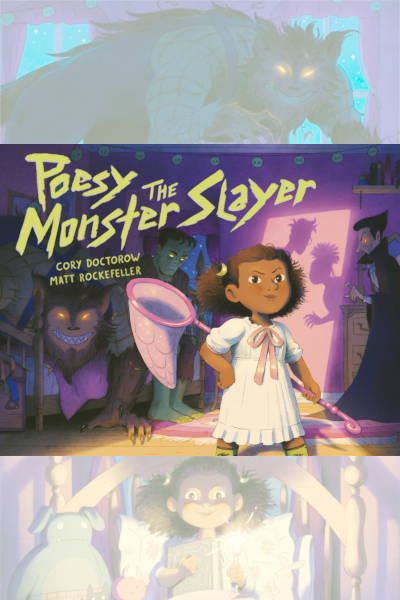
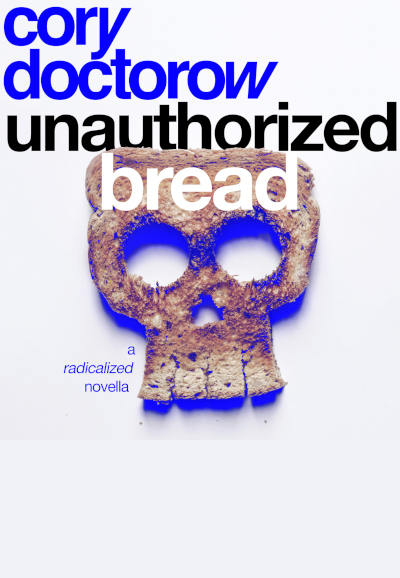
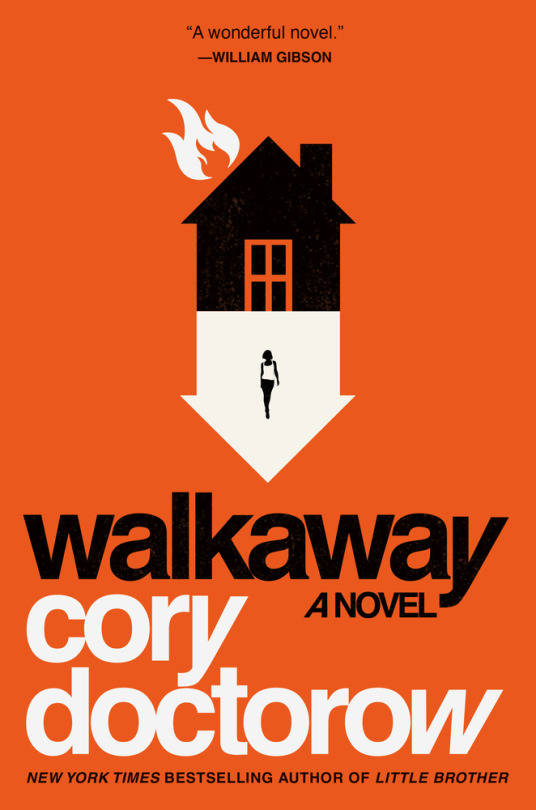
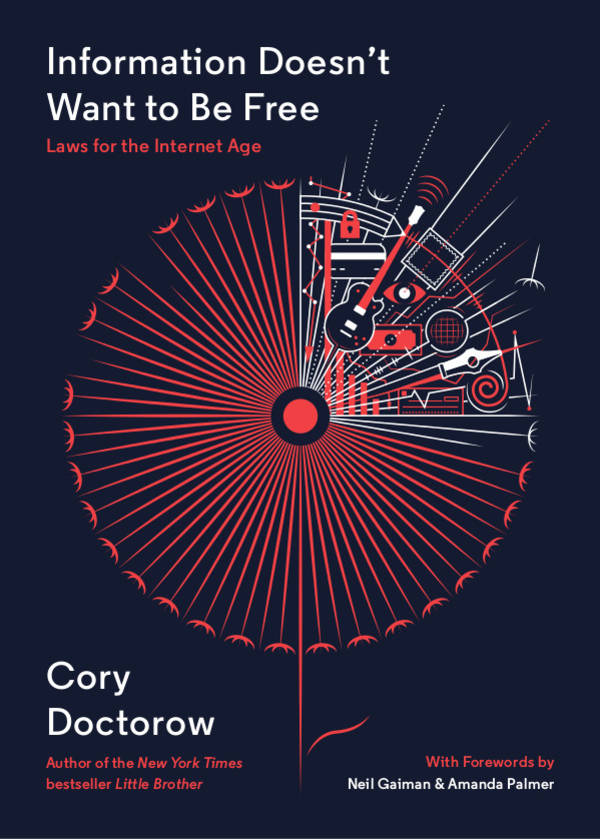
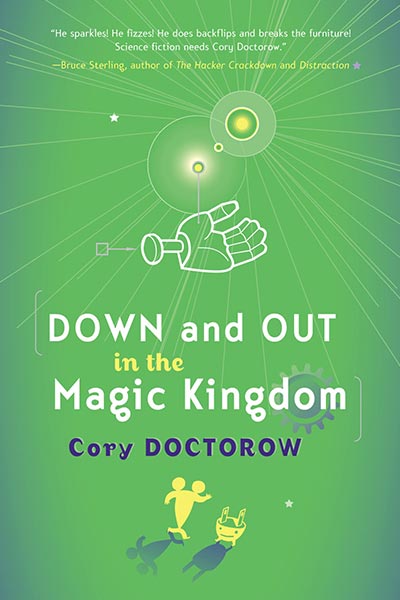
I’m giving a signing and reading for my latest book, Someone Comes to Town, Someone Leaves Town, at London’s Stanhope Centre next Monday, Oct 24 at 6PM. There will be copies of all my books on sale, and the kind folks at Stanhope are also providing “light refreshments.” Hope to see you there!
All About:
News
I’m giving a signing and reading for my latest book, Someone Comes to Town, Someone Leaves Town, at London’s Stanhope Centre next Monday, Oct 24 at 6PM. There will be copies of all my books on sale, and the kind folks at Stanhope are also providing “light refreshments.” Hope to see you there!
I’ve joined the Board of Directors of the Clarion Foundation, a new nonprofit that will manage the Clarion Writers’ Workshop, a “boot-camp for sf writers” at Michigan State University that I graduated from in 1992 and taught this past summer. The workshop runs every summer for six weeks, and accepts some 17 students each year. The format is intensive writing and daily critiquing, with tutelage from six instructors. Past grads include Octavia Butler, Bruce Sterling, Nalo Hopkinson, Kathe Koja, Jeff Vandermeer, Pat York, Lucius Sheppard and innumerable other leading lights of the field. You may recall my review of Kate Wilhelm’s amazing memoir/writing instruction book about her 25+ years teaching Clarion.
The workshop is open for applications for next year, and we’ve just announced our instructor roster:
Plans have been announced for the 2006 workshop, which will run from June 26 to August 4 and will be taught by Samuel R. Delany, Gardner Dozois, Nancy Kress, Joe and Gay Haldeman and, as the traditional anchor team, Kelly Link and Holly Black. The workshop will be returning to Owen Hall where it was held from 1990-2003.
The application deadline for the 2006 workshop is April 1, 2006. Application information is available online at www.msu.edu/~clarion, by email, or by writing to the Clarion Workshop, 112 Olds Hall, Michigan State University, Lansing, MI 48824-1047.
An EU body is negotiating the requirements for a pan-European DRM system. The requirements are really restrictive, and explicitly set out to eliminate both Creative Commons licensed works and free/open source software-based media players. I’ve written and submitted a critique of the proposal:
Given the total failure of DRM to date to enrich creators or prevent unauthorised Internet distribution of works, it is a pity that NAVSHP started with the premise that the world needs more DRM, rather than exploring whether that is indeed the best way to foster the development of the home audiovisual market.
A more reasonable and balanced approach would be to start by asking, “How can we enrich creators and encourage creation?” and “If DRM vendors claim to be able to enrich creators and prevent unauthorised Internet distribution, what evidence can they offer in support of these claims?”
The EU — and the world — is experiencing a revolution in creativity thanks to the Internet. An entire generation of remixers, talented amateurs, and Creative Commons enthusiasts have created over fifty million works that do not require DRM to thrive. A useful work product from NAVSHP would be a set of technology standards recommendations for systems that embrace unrestricted copying, in support of these new, Internet-native business-models. These European creators deserve every bit as much attention from the EU as do American film studios and other incumbents.
It is the author’s opinion that NAVSHP should begin a fresh inquiry to look at the broader question of how DRM technologies impact the marketplace for home audiovisual technologies. This inquiry should be based on the wide range of available empirical data at hand and focus on the following issues:
* Has DRM technology been successful at preventing the unauthorized Internet distribution of material, or have overly broad use-restrictions provided otherwise law-abiding consumers with incentives to find unrestricted material on peer to peer networks?
* What technological systems can enrich creators?
* What technological systems can encourage the creation of new works and new business models?
* What technological needs do “copy-friendly” creators have, and how could standardisation aid them?
Over the past year, I’ve been privileged to participate in the Royal Society for the Arts’ Adelphi Project, through which a drafting committee worked to create a a charter of public rights in copyright, patent, trademark and related rights.
The Charter is intended to be used as a litmus test by governments that are considering new exclusive rights over knowledge goods. These rights are usually granted without any evidence of their promised benefits. As my fellow drafter Jamie Boyle says, “it’s as if the FDA made drug approvals by relying on speeches by pharmaceutical companies and looking at tarot cards.”
The Adelphi Charter marks the first-ever set of empirical principles for evaluating newe xclusive rights proposals. For the first time, we have a test we can hold our lawmakers accountable to. I’m very proud to have been a part of it:
We call upon governments and the international community to adopt these principles.
1. Laws regulating intellectual property must serve as means of achieving creative, social and economic ends and not as ends in themselves.
2. These laws and regulations must serve, and never overturn, the basic human rights to health, education, employment and cultural life.
3. The public interest requires a balance between the public domain and private rights. It also requires a balance between the free competition that is essential for economic vitality and the monopoly rights granted by intellectual property laws.
4. Intellectual property protection must not be extended to abstract ideas, facts or data.
5. Patents must not be extended over mathematical models, scientific theories, computer code, methods for teaching, business processes, methods of medical diagnosis, therapy or surgery.
6. Copyright and patents must be limited in time and their terms must not extend beyond what is proportionate and necessary.
7. Government must facilitate a wide range of policies to stimulate access and innovation, including non-proprietary models such as open source software licensing and open access to scientific literature.
8. Intellectual property laws must take account of developing countries’ social and economic circumstances.
9. In making decisions about intellectual property law, governments should adhere to these rules:
* There must be an automatic presumption against creating new areas of intellectual property protection, extending existing privileges or extending the duration of rights.
* The burden of proof in such cases must lie on the advocates of change.
* Change must be allowed only if a rigorous analysis clearly demonstrates that it will promote people’s basic rights and economic well-being.
* Throughout, there should be wide public consultation and a comprehensive, objective and transparent assessment of public benefits and detriments.
Salon’s just published part six of my novel-in-progress, Themepunks. In this installment, Tjan — the business manager — takes a job at a rival company and Andrea gets slimed by a dirty journo:
Andrea’s PDA vibrated whenever the number of news stories appearing online mentioning her or Kodacell or Kettlewell increased or decreased sharply. She used to try to read everything, but it was impossible to keep up — now all she wanted was to keep track of whether the interestingness-index was on the uptick or downtick.
It had started to buzz that morning and the pitch had increased steadily until it was actually uncomfortable in her pocket. Irritated, she yanked it out and was about to switch it off when the lead article caught her eye.
KODACELL LOSES TJAN TO WESTINGHOUSE
The byline was rat-toothed Freddy. Feeling like a character in a horror movie who can’t resist the compulsion to look under the bed, Andrea thumbed the PDA’s wheel and brought up the whole article.
Kodacell business-manager Tjan Lee Tang, whose adventures we’ve followed through Andrea Fleeks’s gushing, besotted “blog” posts…
She looked away and reflexively reached toward the delete button. The innuendo that she was romantically involved with one or more of the guys had circulated on her blog’s message boards and around the slashdots ever since she’d started writing about them. No woman could possibly be writing about this stuff because it was important — she had to be “with the band,” a groupie or a whore.
Mark Forman is the podcaster who’s been serializing my novel Down and Out in the Magic Kingdom read aloud, one chapter at a time, with backing from great, Creative Commons-licensed music. Today he concluded the reading with chapters nine and ten in one installment. Now he’s embarked upon his next project, reading Lessig’s magnificent Free Culture.
(Thanks, Mark!)
Mark Forman is the podcaster who’s been serializing my novel Down and Out in the Magic Kingdom read aloud, one chapter at a time, with backing from great, Creative Commons-licensed music. Today he concluded the reading with chapters nine and ten in one installment. Now he’s embarked upon his next project, reading Lessig’s magnificent Free Culture.
(Thanks, Mark!)
My story Truncat (a sequel to Down and Out in the Magic Kingdom) has been translated into German by Magnus Wurzer. The translation is called Schnipsel and it’s licensed under a Creative Commons license.
My story Truncat (a sequel to Down and Out in the Magic Kingdom) has been translated into German by Magnus Wurzer. The translation is called Schnipsel and it’s licensed under a Creative Commons license.