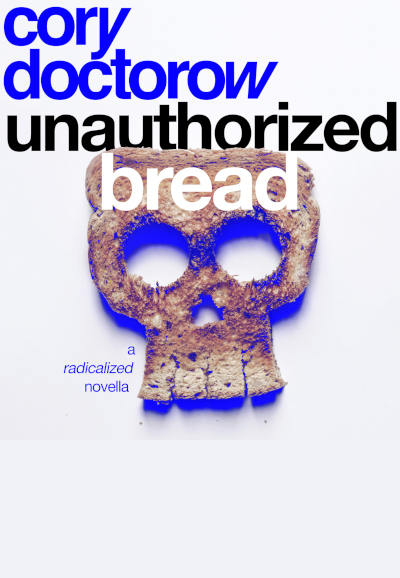
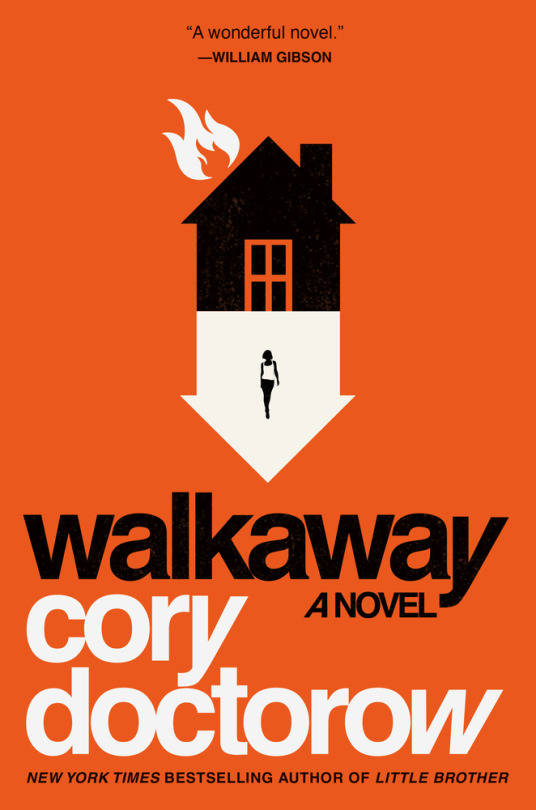
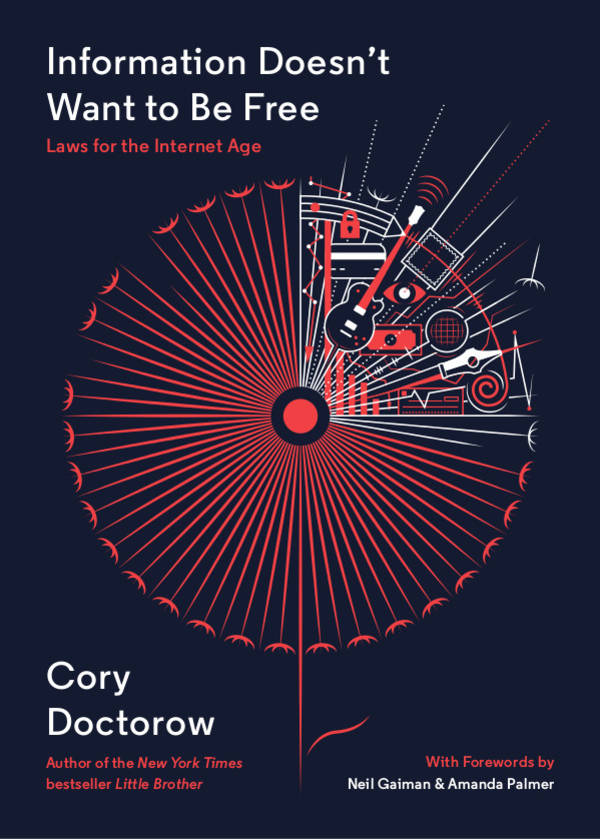
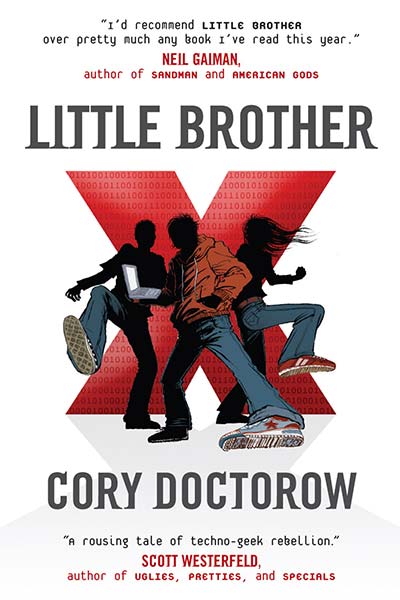
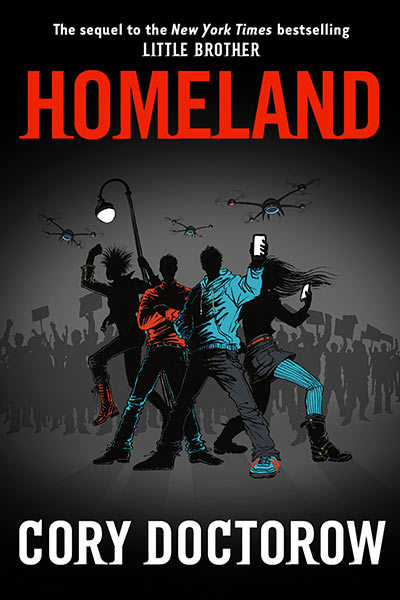
Josh Costello has adapted my novel Little Brother for stage in San Francisco (this is new adaptation, unrelated to the production that ran in Chicago a few years back). The show opens in January, 2012, and he’s just gone into production; he’s keeping running notes of his progress at a blog called LITTLE BROTHER LIVE.
All About:
News
My latest Locus column, “No Endorsement,” talks about how print-on-demand, 3D printers, and other technologies that make products available when people want them change the economics of fannish activity, fan art, and homemade merchandise. I propose a “”No Endorsement” badge that fans could use that indicates, “The creator of the work from which is this derived hasn’t reviewed or approved this; but s/he is still getting a piece of the action.”
Here’s how that could work: tens, hundreds or thousands of fans with interesting ideas for commercially adapting my works could create as many products as they could imagine and offer them for sale through i.Materialise or Shapeways. There’s no cost – apart from time – associated with this step. No one has to guess how many of these products the market will demand and produce and warehouse them in anticipation of demand. Each product bears the ‘‘no endorsement’’ mark, which tells you, the buyer, that I haven’t reviewed or approved of the product, and if it’s tasteless or stupid or ugly, it’s no reflection of my own ideas. This relieves me of the duty to bless or damn the enthusiastic creations of my fans.
But it also cuts me in for a piece of the action should a fan hit on a win. If your action figure hits the jackpot and generates lots of orders, I get paid, too. At any time, we have the option of renegotiating the deal: ‘‘You’re selling so many of these things, why don’t we knock my take back to ten percent and see if we can’t get more customers in the door?’’ Setting the initial royalty high creates an incentive to come to me for a better deal for really successful projects.
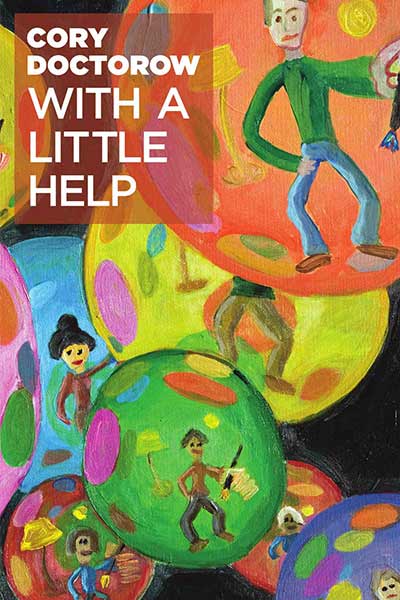
My latest Publishers Weekly column, “Heuristics,” documents the success I’ve had with a pay-what-you-like donation model for my With a Little Help DIY short story collection, and looks at how it might be applied to other books:
But it’s the success of the donations program that has me thinking hardest—specifically, about the value proposition of the donations. Could donations form the basis of a new retail channel for e-books? Perhaps a widget that commercially published authors could embed in their own Web sites and social media pages based around this pitch: “Buy my e-book on a pay-what-you-like basis, and I’ll split the take 50–50 with my publisher, still a much better take than I’d get from your e-book purchases on Amazon, Nook, or iBooks.”
Why not? Commercial entertainment conglomerates understand that “pay creators, it’s the right thing to do” is a better pitch than “pay multinational entertainment conglomerates, they deserve your money.” This is why so many antipiracy ads focus on creators, not on corporate profits. Authors who collect directly from readers have a commercially valuable moral high ground, and figuring out how to incorporate the special relationship between creators and their audiences into a business model has the potential to rebalance the current relationship with the existing online retail channels.
It’s not unprecedented—pay-what-you-like programs like the Humble Indie Bundle (video games) and Radiohead’s In Rainbows and Nine Inch Nail’s Ghosts I–IV (music) have been runaway successes. The pitch from these projects, “pay the creator you love,” is a message that clearly resonates with my readers, some of whom have donated as much as $200. And this can help with the “pig-in-a-poke” problem. Without locked-in channels or DRM-laden works, authors and publishers can put together new titles in a single package to cross-promote their works—new writers could be bundled with established ones, for example. The Humble Indie Bundle has been very successful with this strategy. Readers could even nominate some of their payment for charity—say PEN, a library friends organization, a literacy trust, Creative Commons, the Electronic Frontier Foundation, or ACLU.

My wife Alice and I did a two-for-one interview with the Rum Doings podcast, a gamey, geeky good time: “Amazingly we get onto the economy of Star Trek, via the consequences of teleporters. There is much discussion of the consequences of new technology on, well, everything. And then comes piracy, geocoding, and the surprise appearance of LittleBigPlanet developer, Luke Petre. Finally, we move on to talking about MakieLab’s project to develop 3D toys linked to online gaming.”

The current ish of Redstone Science Fiction includes a reprint of my story 0wnz0red, along with a short story called “The Memory Gatherer” by Morgan Dempsey and “Breaking Heinlein’s Third Rule: Exercises for Revision,” an essay by Sarah Einstein.
The Random House audiobook edition of my novel Little Brother is a free MP3 download this week through Sync, a program that develops the audience of teen/YA audiobook listeners (it’s paired with Kafka’s The Trial, which is pretty cool). The file itself can only be downloaded with a proprietary downloader from Overdrive, which I couldn’t run under WINE on my GNU/Linux system, so I’m not sure how the process goes, but once you’ve actually gotten the file, it’s yours to keep for personal use as a plain-vanilla MP3 with no DRM.
The Random House audiobook edition of my novel Little Brother is a free MP3 download this week through Sync, a program that develops the audience of teen/YA audiobook listeners (it’s paired with Kafka’s The Trial, which is pretty cool). The file itself can only be downloaded with a proprietary downloader from Overdrive, which I couldn’t run under WINE on my GNU/Linux system, so I’m not sure how the process goes, but once you’ve actually gotten the file, it’s yours to keep for personal use as a plain-vanilla MP3 with no DRM.
MIT’s Technology Review is putting out an electronic science fiction anthology called TR:SF; I wrote a story for it about the future of “Internet of Things” called “The Brave Little Toaster” that was pretty fun. Other stories in the book will also focus on contemporary technology subjects.
My latest Guardian column, “Publishers and the internet: a changing role?” looks at how today it’s possible to “publish” a work without distributing it, without duplicating it, without doing any more than connecting a work with its audience, sometimes without knowledge (or permission) from the work’s creators:
In a world in which producing a work and getting it in front of an audience member was hard, the mere fact that a book was being offered for sale to you in a reputable venue was, in and of itself, an important piece of publishing process. When a book reached a store’s shelf, or a film reached a cinema’s screen, or a show made it into the cable distribution system, you knew that it had been deemed valuable enough to invest with substantial resources, not least a series of legal agreements and indemnifications between various parties in the value chain. The fact that you knew about a creative work was a vote in its favour. The fact that it was available to you was a vote in its favour.
Partly, this was the imprimatur of the creator and publisher and distributor and retailer, their reputation for selecting/producing works that you enjoy. But partly it was just the implicit understanding that no company would go to all the bother of putting the work in your path unless it was reasonably certain it would recoup. So “publishing” and “printing” and “distributing” all became loosely synonymous.
After all, it was impossible to imagine that a work might be distributed without being printed, and printing things without distributing them was the exclusive purview of sad “self-publishers” who got conned by “vanity presses” into stumping up for thousands of copies of their memoirs, which would then moulder in their basements forever. But just as the internal functions of publishing were separated out at the tail of the last century, this century has seen a separation of selection, duplication, preparation and distribution. Every work on the internet can be “distributed” by being located via a search-engine without ever being selected or duplicated or prepared.
Make Magazine’s just reprinted my column, “Moral Suasion,” in its online edition. It’s a discussion of the politics of cloud computing, including denial-of-service attacks against cloud providers who cave to government pressure:
I grew up in the antiwar movement and participated in my first sit-in when I was 12. Sit-ins are a sort of denial of service, but that’s not why they work. What they do is convey the message: “I am willing to put myself in harm’s way for my beliefs. I am willing to risk arrest and jail. This matters.” This may not be convincing for people who strongly disagree with you, but it makes an impression on people who haven’t been paying attention. Discovering that your neighbors are willing to be harmed, arrested, imprisoned, or even killed for their beliefs is a striking thing.And that’s a crucial difference between a DDoS and a sit-in: participants in a sit-in expect to get arrested. Participants in a DDoS do everything they can to avoid getting caught. If you want to draw a metaphor, DDoSers are like the animal rights activists who fill a lab’s locks with super glue. This is effective at shutting down your opponent for a good while, but it’s a lot less likely to draw sympathy from the public, who can dismiss it as vandalism.

(Image: Sit-in “Giornata degli studenti”, a Creative Commons Attribution Share-Alike (2.0) image from retestudentimassa’s photostream)