/ / Down and Out In the Magic Kingdom, News

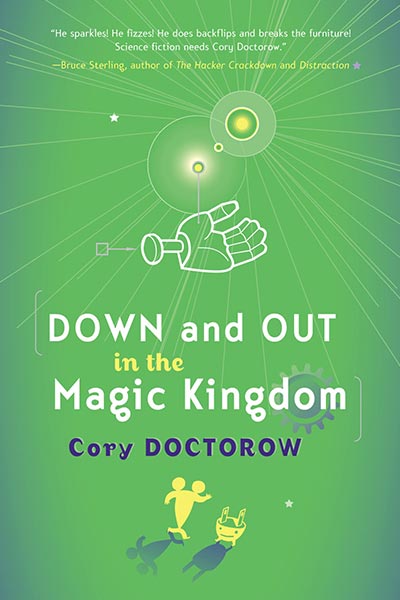
Richard Koman has posted a long, wide-ranging interview with me on the O’Reilly Network, mostly about the book, but very wide-ranging, covering the future and past of the recording industry, the history of the Disney corporation, power-law distributions and such.

So there’s this world I’ve written about called the Bitchun Society. And in the Bitchun Society there’s no more scarcity, there’s a kind of Clarke’s Law technology that allows them to reproduce anything at zero incremental cost. And what’s more, they don’t die. You regularly check yourself into a clinic or terminal and make a copy of your brain and if you die they make a new you and pour that back into it. Lucky for me it’s science fiction and not science so I don’t have to explain the workings of this stuff.

I also don’t have to explain the working of the neural interface, which in addition to allowing them to do this suck-your-brains-out-and-drop-it-onto-a-hard-drive thing, also is capable of figuring out how you feel about any given thing anywhere in the world that you have any opinion about–without asking you. And as a consequence of this, you can first of all make some guesses about how you’re going to feel about something. You don’t have to remember whether you’ve been to this restaurant because the system remembers and tells you what other good restaurants are nearby. But the second-order effect is it will figure out who you hold in high esteem, who has an opinion about some restaurant you’ve never been to. And this opinion, and this esteem is called Whuffie.


/ / Down and Out In the Magic Kingdom, News

One of my favorite authors, Paul Di Filippo, reviews Down and Out in the Magic Kingdom in this week’s SF Weekly:

In any case, what we have here is a rare example of post-Singularity fiction. The Singularity, or Spike, is deemed to be that moment at which mankind emerges into transhuman existence, with or without the help or hindrance of strong AI. (Doctorow eschews the AI, for the most part.) Envisioning such a future is one of the hardest tasks an SF writer can take on, but Doctorow proves himself equal to the challenge. His reorganization of society into ad-hocs craving Whuffie derives a lot from present-day cyber-culture (Slashdot, and all that), and his biomorphic mutability seems positively Extropian. But the exact mix is unique, especially when the fixation on Disney World as a kind of prototype for artificial landscapes is thrown in. And surely Jules’ jazzy first-person narration, laden with future jargon, is essential to the success of the tale. Although readers might initially balk a bit when encountering on the second page of the book a sentence such as “I took! a moment to conjure a HUD with his Whuffie score on it.”

“Ten thousand years ago, the state of the art was a goat,” opines Dan at one point. Well, by that measure Down and Out in the Magic Kingdom is some kind of transgenic supergoat whose milk is full of spidersilk proteins and nutraceuticals.

/ / Down and Out In the Magic Kingdom, News

SFRevu is running an interview with me, and a review of Down and Out in the Magic Kingdom:

Ern: If you don’t count that as SF, what was your first identifiably SF or Fantasy experience?

Cory: It was actually a story-telling experience. My dad had grown up on Conan comics and the Robert E. Howard books, and he retrofitted Conan storylines into Socialist parables that he used to tell me on long car trips. Starring a multiethnic, gender balance trio called Harry, Mary and Larry. So I grew up on these sort of redacted Conan stories that been worked out as parables about workers paradise stories. There are a lot of first and second generation Marxists in Science Fiction today, you’ve got people like Stephen Brust, and China Miéville and Ken McLeod. The techno-utopianism is the one thing you never shake when you grow up in a Marxist household; it’s the unshakeable faith that technology can affect positive social change.

/ / Down and Out In the Magic Kingdom, News

Shift Online has published a great, long article about the ways that the Bitchun Society parallels our present day world, based on an interview we did.

But here’s the kicker: Democracy — or the version of it that we know now anyway, that we’re most comfortable with — is already changing in the real world. Put on your Cory Doctorow goggles and re-examine today’s political landscape: “Internet politics are increasingly post-left-right dichotomy,” he says. “The medium is the message — I think that the internet makes you into a libertarian to a certain extent. Because you can see non-hierarchical, non-centralized systems working, and it becomes hard to credibly claim that we need increased centralization in order to create order or equity or equitableness.” We’ve seen that with the fall of Yahoo, he explains, which was a centralized listing of what was on the internet, edited by a very small group of individuals. The sites on Google, on the other hand, are ranked by everyone who owns a website. “It’s hard to be a left-winger in the sense of a centralized authority-endorsing individual, or a right-winger in that sense. There are lots of strange bedfellows that have been made, certainly. My friend Patrick Nielson Hayden was just in the march in D.C. and he described marching in a blogger contingent that included someone who was carrying a sign that said ‘Peace Now, Socialism Never’ alongside people who were old lefty red-diaper baby types.”

In such a climate, one of decentralization where the only criteria for participating in a movement is your belief in the cause at hand, maybe a Disney World overrun by fans isn’t quite so hard to fathom.

/ / Down and Out In the Magic Kingdom, News

Dave Green has written a great piece about the economics of the Bitchun Society in the Guardian.

The problem with having everything you need is that it isn’t very dramatic. If you’ve heard that Cory Doctorow’s free-to-download sci-fi novel, Down And Out In The Magic Kingdom, depicts a near-future utopia that’s seen “the death of scarcity” (and “the death of death”), you might be wondering what sources of narrative tension might be left. Or is it all: “Tuesday. Got up. Had no shortage of anything I might possibly require. Wrote some music. Surfed the internet. Went to bed”?

Fortunately, it’s a bit more exciting than that. In the book, nanotechnology takes care of everyone’s basic needs, eliminating material scarcity. Handily, the “Bitchun Society” depicted by Doctorow doesn’t share our hangups with intellectual property either, which is all available online. As a result, the population doesn’t have any need for money. Instead, what they aspire to is “Whuffie”, which serves some of the functions of currency, but is much closer to such concepts as “the approval of your peers” or “respect”.

/ / Down and Out In the Magic Kingdom, News

Update, Feb 29, 2004: Sadly, I no longer live close to Borderlands, the bookstore that was shipping inscribed copies for me — in fact, I now live 9,000 miles away! However, Borderlands still has a large supply of signed books and bookplates, and is happy to keep on selling them via mail-order wtih no shipping costs.

Looking for a signed copy of Down and Out in the Magic Kingdom? By a happy coincidence, I live a couple blocks from Borderlands Books, an excellent science fiction bookstore in San Francisco that is happy to do mail-order.

So, if you’re interested in a signed copy, you can call (888.893.4008), fax (415.824.8543), or email your order to the store, and they’ll send you a copy (while supplies last!). There is no charge for media-mail shipping within the continental US.
Priority mail in the US will be $6.00 (that’s delivery within three
days or so). International will be Global Priority for $10 to Canada or
$12 elsewhere. To get the free shipping, just mention that you heard
about it here.

/ / Down and Out In the Magic Kingdom, News

Foreword, the Book Design Blog, has posted an interview with me about the publication of the book and what it means for book-design in general.

Foreword: You’re allowing the book to be converted to HTML with customizable style sheets to suit an individual’s design/viewing pleasure. Do you see customizable books as a coming trend?

Doctorow: I see customizable data-presentation as an existing trend. We’re already accustomed to copying and pasting, resizing windows, up-sizing type. I think that when “book” meets “Web,” we’re not talking about a book anymore — just another text-file.

Foreword: Beyond that, where do you see the role of books going in our society? Will books become a swappable digital commodity, much like music has been and video is becoming?

Doctorow: Absolutely. I think that electronic text already dwarfs hardcopy text. More words are written and read off a screen today than off of paper.

/ / Down and Out In the Magic Kingdom, News

Tim Jarrett records William Gibson’s response to a question about ebook distribution, both authorized and un-

“A colleague of yours in SF and blogging, Cory Doctorow, just released a novel simultaneously in print and in free download. It appears to be working well for him. What do you think this says about the future of publishing, or the book business in general?” Which was in retrospect not the wisest thing to ask, since (a) I”m sure someone from his publisher was there and (b) I was almost inviting him to take a stand on DRM in front of a software publisher that does DRM. But hey, why not?

He replied, “Someone said to me, and it”s an idea that I”m sitting on but I”m not entirely sure I disagree with, that piracy is a tax on popularity; it”s only the guys who are already on the bestseller lists who get downloaded.” Which I think is a way of saying that whether books are downloaded or sold in hard copy, there is still the awkward question of fame to determine whether you can make a living from them. I think I need to think about it some more.