/ / News

Ariel Maidana has produced a Spanish fan-translation of Printcrime, the short-short story that opens my latest collection, Overclocked. Like all the stories in that book, Printcrime is licensed under a Creative Commons Attribution-NonCommercial-ShareAlike license that encourages readers to play with, remix and adapt the text.

Los policías machacaron la impresora de mi padre cuando yo tenía ocho años. Recuerdo su olor como de papel film recién salido del microondas, y la mirada de feroz concentración de Pa cuando la llenaba con pasta fresca, y el aire cálido, como recién horneado, de los objetos que salían de ella.

Los policías entraron por la puerta agitando sus porras, uno de ellos recitando los términos de la orden de allanamiento con un megáfono. Uno de los clientes de papá lo había vendido. La ipolicía pagaba en fármacos de alta calidad — mejoradores de rendimiento, suplementos para la memoria, estimulantes metabólicos. La clase de cosa que cuesta una fortuna sin receta; la clase de cosa que podrías imprimir en casa, si no te importara el riesgo de tener tu cocina llena con una súbita aglomeración de cuerpos grandes y robustos, grandes porras agitándose en el aire, machacando a cualquier persona o cosa que se pusiera en su camino.

Link

/ / News

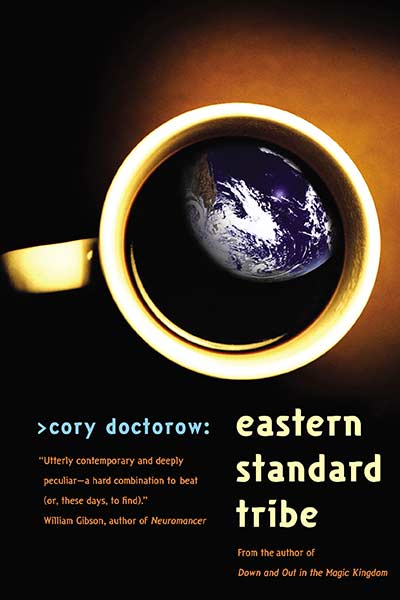
Joe Falconer of the band Midnight.Haulkerton has done another song based on one of my works — this time, a track based on my novel Eastern Standard Tribe. The song is CC-licensed (as is the book) and ready for you to share and play with.

What is the theme of this story?
What is the theme of life?
Do you want to be smart? Do you want to be remembered?
Do you want to be happy? Do you want to be content?
If you want to be smart gotta be unhappy
If you want to be happy gotta live in ignorant bliss
If you want to be remembered gotta go down in flames
If you want to be content you ain’t gonna be missed

Link

/ / News

I’m in Melbourne, Australia for the Melbourne Writers’ Festival and a number of people have written to see if I can get together for coffee or a meal. Unfortunately, my schedule’s too tight for much socializing. Lucky for me, Lachlan Musicman, Guy, and Michael Hillis have put forward a venue for a public get-together for snacks and a drink or two before my first gig.

We’re meeting at a Japanese place called Chocolate Buddha — an informal place that’s vegetarian-friendly. We’re getting together there from 8-9PM on Friday, 24 August. There’s no reservation — we’re just going to turn up and commandeer some tables. The next night, I’ll be at Merlyn Theatre for “Free and easy,” an interview with my by The Chaser’s Charles Firth, along with anyone who wants to attend.

Hope to see you there!

Where: Chocolate Buddha, Federation Square, Melbourne
When: Friday, August 24, 8-9PM

Link

See also: Cory’s schedule at Melbourne Writers’ Festival, Aug 25-26

/ / News

At this year’s Comic-Con, I sat down for a joint iFanBoy interview with Brian Wood, creator of DMZ, one of the best new comics of the decade. Brian and I talked about creators’ rights, copyright, my forthcoming comics, the next volume of DMZ (which I wrote the intro for) and other assorted bits.

Link

(Thanks, Ron!)

See also:
DMZ: graphic novel, a worthy successor to Transmetropolitan
Demo: Brian Woods’s comic about teens with “powers”

/ / News

I’m a program participant at the World Science Fiction in Yokohama, Japan this year. Hope to see many of you there! Here’s my schedule:

Thursday, August 30, 4PM: How to Make SF More Inviting to Teens, with David M. Silver, Farah Mendelsohn, Lisa C. Freitag, Patrick Nielsen Hayden

Friday, August 31, 11AM: Reading

Friday, August 31, Noon: Digital Maoism: Drowning the Individual Voice, with Eileen Gunn, Chris O’Shea

Friday, August 31, 4PM: The Tech Savvy Criminal, with Geoffrey A. Landis, Patricia MacEwen

Saturday, September 1, noon: Mundane or Transcendent? with Charles Stross, Robert Silverberg

Saturday, September 1, 2PM: The Universal Library, with Charles Stross, Linda Robinett, Patrick Nielsen Hayden, Tom Galloway

Sunday, September 2, 10AM: Kaffeeklatsche

Sunday, September 2, Noon, Defending Public Domain from Corporate Copyright Maximalism, with Inge Heyer, Naomi Novik, Patrick Nielsen Hayden

I’ll also be presenting the Hugo Award for Best Novelette.

Link

/ / News

My latest Guardian column has just gone up — it talks about the “Potemkin Village” effect with DRM, whereby DRM vendors walk their potential customers through a faked-up demo showing how great DRM is, how much people want it, and how easy it is to use. The latest victim of this scam is the BBC, who’ve just decreed that their TV shows will only be delivered online through the iPlayer, a DRM service that lets you do less than you can with your old TV and VCR. Because that’s what the public is crying out for: an Internet TV that does less than a regular TV.

These demos almost never involve real hardware. It’s so much easier to do interoperability when all it takes to make two devices communicate is to draw a dotted line between them on a slide. And when the demos do involve real hardware, it’s usually all from one vendor, and only within a constrained universe of uses.

In reality, it’s bloody hard to get any two technologies to talk to each other successfully. Remember how hard it was to get your new wireless card, printer or DVD recorder to work? Now, imagine that these technologies had been deliberately designed not to work with each other – except under the exactly correct circumstances.

Microsoft’s PlaysForSure platform is typical of this. All such devices, “certified” to work with each other, barely ran on their own. And God help you if you tried to connect them to a competitor’s device (even Microsoft’s Zune won’t handle PlaysForSure music).

Link

See also: Cory’s column on “Digital Lysenkoism” for the Guardian

/ / News

On Saturday, 25 August and Sunday, 26 August, I’ll be a guest at the Melbourne Writers’ Festival in Melbourne, Australia. I met a ton of wonderful people on my last pass through MEL — hoping to see all of you again. Here’s my schedule:

Saturday, 25 August, 9PM: Free and easy, interview by The Chaser’s Charles Firth, Merlyn Theatre

Sunday, 26 August:
11:30AM: Creative commons or common theft?, panel, Merlyn Theatre
3PM: This just in from cyberspace, panel, Beckett Theatre
5:30: Publish or perish: An A-Z of alternative ways to get your name in print, panel, Tower Theatre

I’m also teaching an all-day writing class on Saturday, called “Generation next,” but I believe that most of the slots are now taken.

Link

/ / News

DailyLit is a fantastic service — they take public-domain and Creative Commons-licensed books and email them to you, one page per day. They put my novel Someone Comes to Town, Someone Leaves Town up last year to great response, and now they’ve added a whole slew of science fiction, including the rest of my novels and my latest short story collection, Overclocked, and many other sf books including Charlie Stross’s Accelerando, Flatland, Frankenstein, From the Earth to the Moon, and The Time Machine.

Link

(Thanks, Jeff!)

/ / News

In my latest column for Information Week, I talk about the Hollywood attempt to re-create the Napster Wars, suing all the funded, legit companies that want to do Internet video, like YouTube. When the record companies did this to Napster, all it did was ensure that the P2P market was saturated with companies that had no interest in doing deals with the record companies — instead, we got rogues like Kazaa and AllOfMP3, whose business-model was built around the difficulty of being sued offshore, not paying the record companies for the use of copyrights.

Now the TV and movie people are following suit — and there’s every chance that they’ll succeed at scaring off all the legit Internet distribution companies. Which will just make ThePirateBay into the world’s biggest, most successful video distribution system.

Napster had an industry-friendly business-model: raise venture capital, start charging for access to the service, and then pay billions of dollars to the record companies in exchange for licenses to their works. Yes, Napster kicked this plan off without getting permission from the record companies, but that’s not so unusual. The record companies followed the same business plan a hundred years ago, when they started recording sheet music without permission, raising capital and garnering profits, and then working out a deal to pay the composers for the works they’d built their fortunes on.

Napster’s plan was plausible. They had the fastest-adopted technology in the history of the world, garnering 52,000,000 users in 18 months — more than had voted for either candidate in the preceding US presidential election! — and discovering, via surveys, that a sizable portion would happily pay between $10 and $15 a month for the service. What’s more, Napster’s architecture included a gatekeeper that could be used to lock out non-paying users.

Link

/ / News

Voices for the Cure is a Lulu press anthology of science fiction stories published to benefit the American Diabetes Association. Many writers — including me — donated stories to the book (I gave them my story Craphound).


Some of the greatest voices in speculative fiction join forces in this one-of-a-kind anthology to benefit the American Diabetes Association. Join Robert J. Sawyer, Mike Resnick, Cory Doctorow, and others as a cop-for-hire solves a murder aboard a space station…a Chicano science fiction writer takes mind-blowing (literally!) ride through the Singularity…a third-rate superhero with useless powers finds a place to belong…an antique collector learns that one alien’s junk is mankind’s treasure…a geologist discovers that pretending to be a god isn’t all it’s cracked up to be…a journalist learns how to fend off zombies using Linux and a dead badger… All this and more await you in… Voices for the Cure: A Speculative Fiction Anthology to Benefit the American Diabetes Association

Link