/ / Little Brother, News

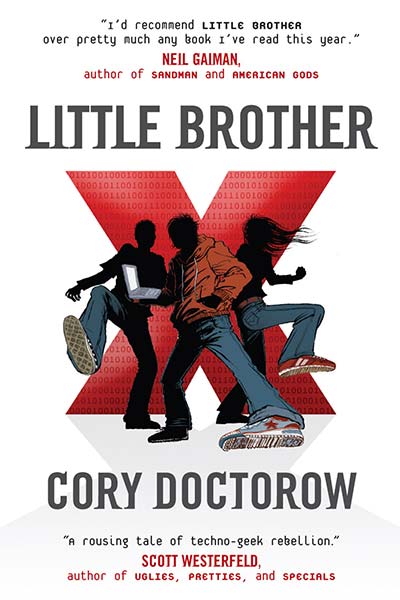
Austin “Soon I Will Be Invincible” Grossman’s written a fantastic review of my young adult novel Little Brother for this weekend’s New York Times book review section. Incidentally, the book went into a fifth hardcover printing last week, and is going back for a sixth printing next week because so many orders came in between the fifth printing being set up and it being delivered!


“Little Brother” is a terrific read, but it also claims a place in the tradition of polemical science-fiction novels like “Nineteen Eighty-Four” and “Fahrenheit 451” (with a dash of “Mr. Smith Goes to Washington”). It owes a more immediate debt to Brian Wood and Riccardo Burchielli’s comic book series “DMZ,” about the adventures of a photojournalist in the midst of a new American civil war. …

MY favorite thing about “Little Brother” is that every page is charged with an authentic sense of the personal and ethical need for a better relationship to information technology, a visceral sense that one’s continued dignity and independence depend on it: “My technology was working for me, serving me, protecting me. It wasn’t spying on me. This is why I loved technology: if you used it right, it could give you power and privacy.”

BTW, if I’m not mistaken, there are still some signed first-edition hardcovers in stock at Bakka Books in Toronto and Borderlands in San Francisco, and both stores ship.

Nerd Activists

/ / News

Austin “Soon I Will Be Invincible” Grossman’s written a fantastic review of my young adult novel Little Brother for this weekend’s New York Times book review section. Incidentally, the book went into a fifth hardcover printing last week, and is going back for a sixth printing next week because so many orders came in between the fifth printing being set up and it being delivered!


“Little Brother” is a terrific read, but it also claims a place in the tradition of polemical science-fiction novels like “Nineteen Eighty-Four” and “Fahrenheit 451” (with a dash of “Mr. Smith Goes to Washington”). It owes a more immediate debt to Brian Wood and Riccardo Burchielli’s comic book series “DMZ,” about the adventures of a photojournalist in the midst of a new American civil war. …

MY favorite thing about “Little Brother” is that every page is charged with an authentic sense of the personal and ethical need for a better relationship to information technology, a visceral sense that one’s continued dignity and independence depend on it: “My technology was working for me, serving me, protecting me. It wasn’t spying on me. This is why I loved technology: if you used it right, it could give you power and privacy.”

BTW, if I’m not mistaken, there are still some signed first-edition hardcovers in stock at Bakka Books in Toronto and Borderlands in San Francisco, and both stores ship.

Nerd Activists

/ / News, Podcast

The Canadian Broadcasting Corporation’s venerable Ideas programme just aired a fantastic one-hour segment on copyright called “Who Owns Ideas?” with a wide range of interviews with me, James Boyle, Steve Page from BNL, Siva Vaidhyanathan, Eric Flint, Michael Geist and many others.

MP3: Who Owns Ideas?

/ / News


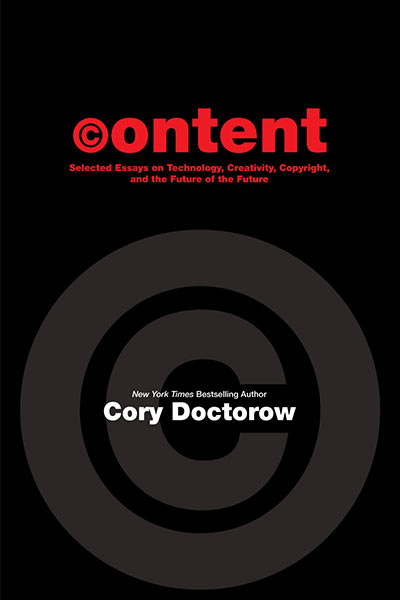
Today, Tachyon Books and I are launching my latest book, Content: Selected Essays on Technology, Creativity, Copyright, and the Future of the Future, my very first collection of essays. In it are 28 essays about everything from copyright and DRM to the layout of phone-keypads, the fallacy of the semantic web, the nature of futurism, the necessity of privacy in a digital world, the reason to love Wikipedia, the miracle of fanfic, and many other subjects. The book sports a very fine Introduction by John Perry Barlow, and was designed by typography legend John D Berry.

I’m especially chuffed about John’s superb design, because I’m giving the whole electronic text away in the hopes of selling more printed objects, and the fact that this is one of the best-looking books I’ve ever read really makes the case for owning the p-book as well as the e-book (there’s an essay on this subject in the book, too, natch).

As with Little Brother, I’m running a donations program for this book: if you love the book and want to donate something to me for it, you can do so by buying a copy for a librarian or teacher (teachers and librarians: you can request a copy for your institution). This worked incredibly well for Little Brother: we’ve gotten hundreds of copies of that hardcover into the hands of worthy, cash-strapped institutions thanks to the generosity of my readers.

Content: Selected Essays on Technology, Creativity, Copyright, and the Future of the Future


/ / Content, News

John D. Berry, a legendary type designer, is responsible for the superb design of Content. I’ve often said that people value the physical book for its physicality (which is partly why giving away downloads leads to sale of the print editions), but rarely has one of my books been so gorgeously physical. The downloadable PDF of the entire book will give you a sense of just how hand-turned, artisinal and deliciously smart the interiors of this book are — if you’re as excited by great type as I am, check out the buy page to get your own copy. And lest I forget, the superb cover came from designer Ann Monn!

/ / Content, News


I can’t begin to express how exciting it was hear that John Perry Barlow would write the introduction to this collection. This is, after all, the man who wrote The Declaration of Independence of Cyberspace, a document that has haunted and moved me since I first read it in 1996. Barlow is one of the most profound, generous, and genuinely kind and thoughtful people I’ve ever met. He is uncompromising, principled, funny and as down to earth as anyone you’ve ever met. If you only read one essay in this collection, read John Perry’s intro.

/ / Content, News

Every time I put a book online for free, I get emails from readers who want to send me donations for the book. I appreciate their generous spirit, but I’m not interested in cash donations, because my publishers are really important to me. They contribute immeasurably to the book, improving it, introducing it to audience I could never reach, helping me do more with my work. I have no desire to cut them out of the loop.

But there has to be some good way to turn that generosity to good use, and I think I’ve found it.

Here’s the deal: there are lots of teachers and librarians who’d love to get hard-copies of this book into their kids’ hands, but don’t have the budget for it (teachers in the US spend around $1,200 out of pocket each on classroom supplies that their budgets won’t stretch to cover, which is why I sponsor a classroom at Ivanhoe Elementary in my old neighborhood in Los Angeles; you can adopt a class yourself here).

There are generous people who want to send some cash my way to thank me for the free ebooks.

I’m proposing that we put them together.

If you’re a teacher or librarian and you want a free copy of Content, email freecontentbook@gmail.com with your name and the name and address of your school. It’ll be posted below by my fantastic helper, Olga Nunes, so that potential donors can see it.

If you enjoyed the electronic edition of Content and you want to donate something to say thanks, check below to find a teacher or librarian you want to support. Then go to Amazon, BN.com, or your favorite electronic bookseller and order a copy to the classroom, then email a copy of the receipt (feel free to delete your address and other personal info first!) to freecontentbook@gmail.com so that Olga can mark that copy as sent. If you don’t want to be publicly acknowledged for your generosity, let us know and we’ll keep you anonymous, otherwise we’ll thank you on the donate page.

Check the donate page for people looking for copies.