/ / Little Brother, News


Diane from the World Science Fiction Convention sez, “Just wanted to drop you a quick note to say that the voting deadline for the Hugo awards is this Friday. Eligible voters must vote online by July 3rd, 23:59PM EST. People should vote as early as possible in case of computer problems and to ensure their ballot is received before the deadline.”


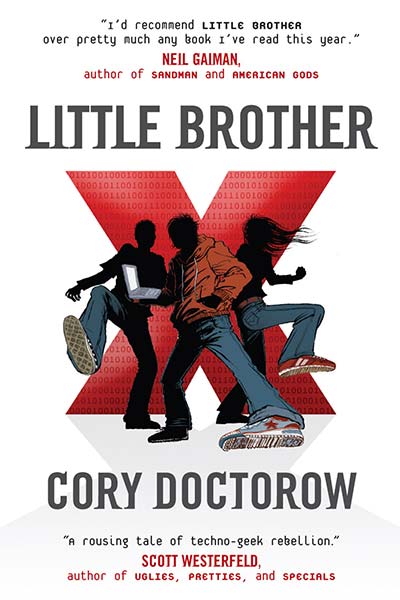
You get a vote if you’re signed up to attend the WorldCon (it’s in Montreal this year). It’s one of the best Hugo ballots I’ve seen in all my years as an sf reader. And yes, I’m eligible twice, once for best novel (Little Brother) and again for best novella (True Names, with Ben Rosenbaum).

Final Ballot for the 2009 Hugo Awards
and John W. Campbell Award


/ / News

My latest Guardian column, “When I’m dead, how will my loved ones break my password?” describes the process my wife and I went through when we drew up our wills and realized that our encrypted hard-drives and our network passwords would go with us if we died or were incapacitated, and how important it was for us to have a secure, long-term solution for decrypting our data if we croak.

I don’t want to simply hand the passphrase over to my wife, or my lawyer. Partly that’s because the secrecy of a passphrase known only to one person and never written down is vastly superior to the secrecy of a passphrase that has been written down and stored in more than one place. Further, many countries’s laws make it difficult or impossible for a court to order you to turn over your keys; once the passphrase is known by a third party, its security from legal attack is greatly undermined, as the law generally protects your knowledge of someone else’s keys to a lesser extent than it protects your own.

I discarded any solution based on putting my keys in trust with a service that sends out an email unless you tell it not to every week – these “dead man’s switch” services are far less deserving of my trust than, say, my wife or my solicitor.

I rejected a safe-deposit box because of all the horror stories I’ve heard of banks that refuse to allow access to boxes until the will is probated, and the data necessary to probate the will is in the box.

I pondered using something called Shamir’s Secret Sharing Scheme (SSSS), a fiendishly clever crypto scheme that allows you to split a key into several pieces, in such a way that only a few of those pieces are needed to unlock the data. For example, you might split the key into 10 pieces and give them to 10 people such that any five of them can pool their pieces and gain access to your crypto-protected data. But I rejected this, too – too complicated to explain to civilians, and what’s more, if the key could be recovered by five people getting together, I now had to trust that no five out of 10 people would act in concert against me. And I’d have to keep track of those 10 people for the rest of my life, ensuring that the key is always in a position to be recovered. Too many moving parts – literally.

When I’m dead, how will my loved ones break my password?

/ / Little Brother, News

My novel Little Brother has won the Campbell Award for best sf novel of the year (sharing the award with Ian MacLeod’s “Song of Time”). The award’s given out over the July 9 weekend at the University of Kansas in Lawrence, KS, and includes free events that are open to the public. Also in attendance will be Ian MacLeod and James Allan Gardner, whose “The Ray Gun: A Love Story” won the Sturgeon award for best short story.

(Funny thing: there’s another Campbell award, given out with the Hugo Awards, for best new sf writer. I won it in 2000, and as near as anyone can work out, I’m the only writer to have won both!).

Hope to see you in Lawrence on July 11/12!

James Gunn, director of the Center for the Study of Science Fiction at the University of Kansas, has announced winners of the 2009 John W. Campbell Award for the best science fiction novel of the year and the 2009 Theodore Sturgeon Award for the best short science fiction of the year.

The Campbell award is shared by Cory Doctorow’s “Little Brother” (Tor Books) and Ian MacLeod’s “Song of Time” (PS Publishing). James Alan Gardner’s “The Ray Gun: A Love Story” won the Sturgeon award. The authors will accept their awards July 10 at KU and will be featured at the Campbell Conference on Saturday, July 11, and Sunday, July 12.

The Campbell Conference will discuss “What’s Old, What’s New: The New Space Opera, the New Hard SF, the New Weird.” In the afternoon session the three winners will open a discussion on what’s new in publishing and its effect on writing and reading.

Science fiction writers earn awards for best novels, short story of the year

/ / News

My novel Little Brother has won the Campbell Award for best sf novel of the year (sharing the award with Ian MacLeod’s “Song of Time”). The award’s given out over the July 9 weekend at the University of Kansas in Lawrence, KS, and includes free events that are open to the public. Also in attendance will be Ian MacLeod and James Allan Gardner, whose “The Ray Gun: A Love Story” won the Sturgeon award for best short story.

(Funny thing: there’s another Campbell award, given out with the Hugo Awards, for best new sf writer. I won it in 2000, and as near as anyone can work out, I’m the only writer to have won both!).

Hope to see you in Lawrence on July 11/12!

James Gunn, director of the Center for the Study of Science Fiction at the University of Kansas, has announced winners of the 2009 John W. Campbell Award for the best science fiction novel of the year and the 2009 Theodore Sturgeon Award for the best short science fiction of the year.

The Campbell award is shared by Cory Doctorow’s “Little Brother” (Tor Books) and Ian MacLeod’s “Song of Time” (PS Publishing). James Alan Gardner’s “The Ray Gun: A Love Story” won the Sturgeon award. The authors will accept their awards July 10 at KU and will be featured at the Campbell Conference on Saturday, July 11, and Sunday, July 12.

The Campbell Conference will discuss “What’s Old, What’s New: The New Space Opera, the New Hard SF, the New Weird.” In the afternoon session the three winners will open a discussion on what’s new in publishing and its effect on writing and reading.

Science fiction writers earn awards for best novels, short story of the year

/ / News

Emma sez,

“Snitchtown: the photo essay” is a book of photographs of a (very small) subset of the 4.2 million CCTV in Britain. These have been put together with Cory Doctorow’s essay on ubiquitous CCTV coverage, “Snitchtown” as part of the SoFoBoMo event, in which photographers work to put together a solo project in book form in one month.

I was inspired by some of the things that Cory said at an Open Rights Group debate. Not least of these was the fact that his daughter’s pocket money was tied, in part, to her spotting the CCTV cameras on the way to school. This sounded so damned transgressive, and I realised how much we’ve been trained to pay no attention to the cameras that record our daily lives (I counted 21 on my exit from the tube station this evening alone.)

The book needed some words to explain why I wanted turn the lens back onto the CCTV cameras. I started by using some extracts from “Snitchtown”, along with quotes from the press, and from CCTV manufacturers’ catalogues. I quickly realised that none of these told the story as cogently as the original essay does. The upshot is a creative commons licensed collection of photographs, a creative commons licensed book (PDF only at the present time, but I plan to put it on a print on demand server.)

I’m very new to photography and I know of many people that could have done a much better job, but I wanted to stand under these cameras and document them. Doing so has made me much more aware of just how ubiquitous they are. I hope the photographs will help others to do likewise.

This is, I believe, my absolute favorite CC adaptation of my work to date; in that it’s the first adaptation that I prefer to my original. Great work, Emma!

Snitchtown

/ / Little Brother, News

Bill Massiola, who adapted my novel Little Brother for a critically acclaimed stage-play running in Chicago right now at the Griffin Theatre Company performing at the Athenaeum Theatre, sent me these three video clips from the production. I’m coming through Chicago on July 9 to see the play (it runs until July 19); based on these clips I’m incredibly excited to see more!

Little Brother stage play

/ / News

Bill Massiola, who adapted my novel Little Brother for a critically acclaimed stage-play running in Chicago right now at the Griffin Theatre Company performing at the Athenaeum Theatre, sent me these three video clips from the production. I’m coming through Chicago on July 9 to see the play (it runs until July 19); based on these clips I’m incredibly excited to see more!

Little Brother stage play

/ / News

I wrote my latest Guardian column after hearing security experts lament, for the nth time, that sensitive systems like MRI machines, defense-contractor computers, and so on should never be connected to the Internet, and when these are compromised by spies, malware or worms, it’s the fault of bad network policy.

I realized that this lament was like the one you hear from people who bemoan kids having sex and getting pregnant or catching diseases, “If they’d just abstain…”

Abstinence programs don’t work — not in IT, and not for teens’ sex:

Every time a state secret disappears from an internet-connected PC, every time a hospital computer reboots itself in the middle of a surgical procedure because it has just downloaded the latest patch, every time an MRI machine gets infected with an internet worm, I hear security experts declaiming, “Those computers should never be connected to the internet!” and shaking their heads at the foolish users and the foolish IT department that gave rise to a situation where sensitive functions were being executed on a computer connected to the seething, malware-haunted public internet.

But no amount of head-shaking is going to change the fact that computers, by and large, get connected. It’s what they’re designed to do. You might connect to the internet without even meaning to (for example, if your computer knows that it’s allowed to connect to a BT Wi-Fi access point, it will connect and disconnect from hundreds of them if you carry it with you through the streets of London).

Operating systems are getting more promiscuous about net connections, not less: expect operating systems to start seeking out Bluetooth-enabled 3G phones and using them to reach out to the net when nothing else is available.

All evidence suggests that keeping computers off the internet is a losing battle. And even if you think you can discipline your workers into staying offline, wouldn’t it be lovely if you had a security solution that worked even if someone broke the rules? “You shouldn’t be having net at your age, but if you do, you should at least practice safe hex.”

Like teenagers, computers are built to hook up

/ / Futuristic Tales Of The Here And Now, News

The folks are Robot Comics have completed their conversion of the comics in my CC-licensed graphic novel Cory Doctorow’s Futuristic Tales of the Here and Now, which adapts six of my stories for comic form.

The Robot Comics editions are free and run on your Android phone and (sometimes) on the iPhone (Apple rejected the adaptation of the award-winning story Anda’s Game because the scene in which a video-game orc is beheaded was “objectionable”). Many have also been translated to Spanish — they’re planning on doing the whole lot. It’s all free, non-commercial, and CC licensed, natch!

Cory Doctorow’s Futuristic Tales of the Here and Now reaches 30,000 downloads

Previously: