/ / News


This month’s Locus magazine contains the annual “Locus Recommended Reading List,” a guide to the best science fiction and fantasy published in the preceding year, chosen by the magazine’s critics.


In addition to being a great primer for exploring the year in fiction, they’re also an excellent cheat-sheet for award-nominations — for example, the Hugo Award nomination deadline is fast approaching. You can nominate for the Hugo if you attended or supported last year’s World Science Fiction Convention in Melbourne, or if you have registered to attend or support this year’s WorldCon in Reno.


I’m delighted to note that two of my stories were included in this year’s Locus List: my novella Chicken Little and my short story The Jammie Dodgers and the Adventure of the Leicester Square Screening. Here’s the full list of my eligible works, in case you’re interested:

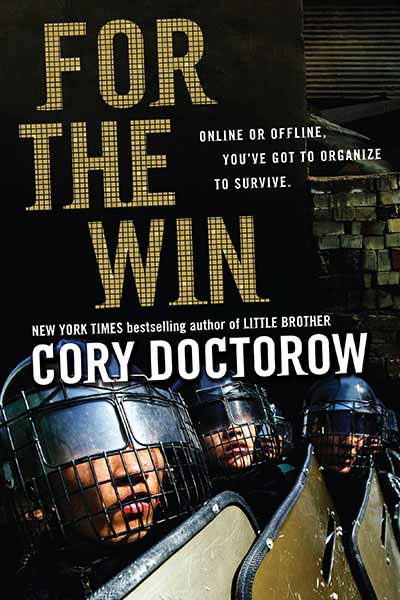
* Novel: For the Win (Tor, 2010)
* Novella: Chicken Little (Gateways, edited by Jim Frenkel, Tor, 2010)
* Novella: Epoch (published in With a Little Help, Sweet Home Grindstone press, 2010)

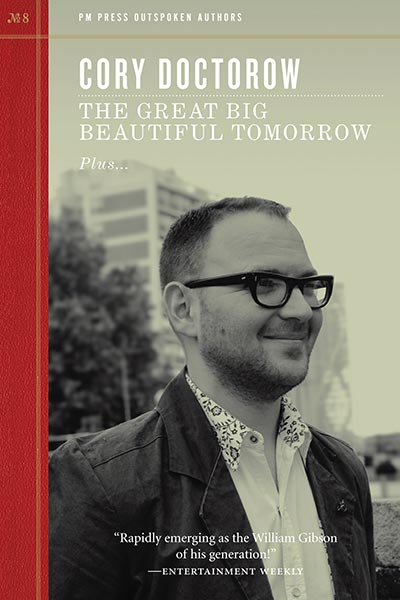
* Novella: There’s a Great Big Beautiful Tomorrow Now is the Best Time of Your Life (published in Godlike Machines, edited by Jonathan Strahan, Science Fiction Book Club, 2010)
* Short story: The Jammie Dodgers and the Adventure of the Leicester Square Screening, (Shareable.net, 2010)
* Short story: Ghosts in My Head (Subterranean Press, 2010)

2010 Locus Recommended Reading List

/ / News, With a Little Help

My latest Publishers Weekly column documenting my DIY short story collection With a Little Help has just gone up. It documents the first six weeks after publication — what went right and what went wrong. The good news is that I’m heavily in the black, thanks, in large part, to the limited edition hardcovers. The bad news is that the paperback sales have been really lacklustre — due to a too-high pricetag, lack of Amazon availability, and a paucity of reviews. Thankfully, these problems can be fixed — and as always, I’m letting future experimenters know how and where I went wrong so that they can avoid the pitfalls that caught me.


First, the good news: I’ve made a ton of money on the $275 limited edition. I’ve already sold more than 50, and I get a new order every day or two, without news or advertising. The recipients have been universally delighted with their purchases and the packaging. The combination of a cardboard book mailer, a section of burlap coffee sack, and acid-free tissue paper is a huge hit, with some customers even producing lavish “unboxing” YouTube videos and Flickr sets.

The typo-hunting project has also been a smash success. My readers have sent in 123 typos to date, about the same as I turned in for the second printing of my first story collection, which was proofed by my editor. With a Little Help was proofed by my mother, who routinely scores on par with professional proofers who do my novels. The number of reported typos has slowed to a tiny trickle, which tempts me to believe I may, in fact, perfect the text of this book, possibly a first in the history of publishing.

Now for the mistakes: first, the minor ones. I blithely assumed that I would spot all the errors without outside help, forgetting a key lesson I’d learned as a software developer. I was wrong. Turns out that I failed to notice that the e-mail addresses for reporting typos and requesting copies for libraries and schools were both malfunctioning. The former took less than a day to fix, but the latter took a month. I also failed to notice that my e-commerce system (the free WordPress eShop plug-in) was adding $15 shipping charges to orders of the hardcover. Thankfully, I noticed this about a day in, but I still had to send refunds to about 10 people who hadn’t noticed they’d been billed for $290 instead of $275.

I’m also unconvinced that having multiple covers was worth the effort. I love all four of the covers that I sourced for the book, but overwhelmingly my readers have chosen the Pablo Defendini cover, which incidentally is the only one without a real painting. What’s more, having four covers has geometrically multiplied the complexity of updating the text (to fix typos). Having done about 100 re-uploads of the source file to Lulu’s system—which is decidedly not optimized for editing your books several times a day—I’ve probably lost a good five hours to maintaining the separate editions. If I was starting over right now, I’d probably go with one cover, though I’d solicit several sketches and try them out on my Twitter followers to pick the best. But now that I have four covers I can’t see any reason to eliminate any of them.

With A Little Help: The Early Returns

/ / News

My latest Publishers Weekly column documenting my DIY short story collection With a Little Help has just gone up. It documents the first six weeks after publication — what went right and what went wrong. The good news is that I’m heavily in the black, thanks, in large part, to the limited edition hardcovers. The bad news is that the paperback sales have been really lacklustre — due to a too-high pricetag, lack of Amazon availability, and a paucity of reviews. Thankfully, these problems can be fixed — and as always, I’m letting future experimenters know how and where I went wrong so that they can avoid the pitfalls that caught me.


First, the good news: I’ve made a ton of money on the $275 limited edition. I’ve already sold more than 50, and I get a new order every day or two, without news or advertising. The recipients have been universally delighted with their purchases and the packaging. The combination of a cardboard book mailer, a section of burlap coffee sack, and acid-free tissue paper is a huge hit, with some customers even producing lavish “unboxing” YouTube videos and Flickr sets.

The typo-hunting project has also been a smash success. My readers have sent in 123 typos to date, about the same as I turned in for the second printing of my first story collection, which was proofed by my editor. With a Little Help was proofed by my mother, who routinely scores on par with professional proofers who do my novels. The number of reported typos has slowed to a tiny trickle, which tempts me to believe I may, in fact, perfect the text of this book, possibly a first in the history of publishing.

Now for the mistakes: first, the minor ones. I blithely assumed that I would spot all the errors without outside help, forgetting a key lesson I’d learned as a software developer. I was wrong. Turns out that I failed to notice that the e-mail addresses for reporting typos and requesting copies for libraries and schools were both malfunctioning. The former took less than a day to fix, but the latter took a month. I also failed to notice that my e-commerce system (the free WordPress eShop plug-in) was adding $15 shipping charges to orders of the hardcover. Thankfully, I noticed this about a day in, but I still had to send refunds to about 10 people who hadn’t noticed they’d been billed for $290 instead of $275.

I’m also unconvinced that having multiple covers was worth the effort. I love all four of the covers that I sourced for the book, but overwhelmingly my readers have chosen the Pablo Defendini cover, which incidentally is the only one without a real painting. What’s more, having four covers has geometrically multiplied the complexity of updating the text (to fix typos). Having done about 100 re-uploads of the source file to Lulu’s system—which is decidedly not optimized for editing your books several times a day—I’ve probably lost a good five hours to maintaining the separate editions. If I was starting over right now, I’d probably go with one cover, though I’d solicit several sketches and try them out on my Twitter followers to pick the best. But now that I have four covers I can’t see any reason to eliminate any of them.

With A Little Help: The Early Returns

/ / News

My latest Guardian column is “Government data like crime maps is not enough – there needs to be action,” and it looks at two recent data-crunching apps for UK policing: first, the crime-maps that tell you what the crime’s like in your neighbourhood, and second, Sukey, an app that helps protesters evade police “kettling” — an inhumane form of arbitrary detention practiced by police.

When the citizenry need to build apps to protect themselves from unlawful detention by the police, it’s not surprising that a new application that allows you to go down to your local police station and ask them to do something about some newly transparent crime statistic is greeted with indifference or jeers. If you can’t trust the police not to detain your children on a freezing road for hours, why would you believe that you could have a productive dialogue about how they should be deploying their resources?

After all: tuition fee rises are a complete reversal of a critical Lib Dem pledge; mass NHS redundancies for nurses and other frontline workers are a complete reversal of a critical Tory pledge. When you’ve voted for a party that promises one thing and does the opposite, no amount of data about how rotten things are will inspire you to join a “big society” that works with the state to accomplish its aims.

Meanwhile, Sukey’s authors cleverly included a facility in their app that allows the police to communicate with demonstrators who are using it – an architecture for dialogue, built right in at the code level. If this was a “big society”, then the police would be using that channel to come to some accommodation with protestors that acknowledged the fundamental right to peaceful protest. But the radio silence to date tells us exactly why the crime map will serve no purpose: what good is it to know how your taxes are spent if you don’t believe that anyone will listen when you complain?

Government data like crime maps is not enough – there needs to be action

/ / News


This March, the University of Toronto’s Faculty for Information is bringing me to Toronto to give a keynote at its Boundaries, Frontiers and Gatekeepers conference. Admission is free for U of T iSchool students. For others, the keynote is $5 at the door, or the whole event is $7 for non-U-of-T-students and $10 for the general public. The keynote is on March 5, from 5-7PM.

While I’m in town, I’m also doing a reading and signing on March 6 with David Nickle and Karl Schroeder for Chiaroscuro, at Augusta House at 152 Augusta Ave. The event runs 8-11PM, and is free.

Keynote at iSchool Boundaries, Frontiers and Gatekeepers conference
March 5, 5-7PM
University of Toronto Earth Sciences Centre, Bancroft Avenue
Details: iSchool


Reading with Karl Schroeder and David Nickle
March 6, 8-11PM
Augusta House, 152 Augusta Avenue
Details: Chiaroscuro