/ / News, With a Little Help

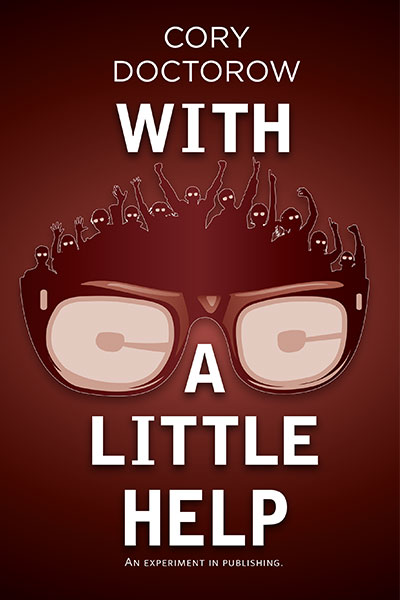
My new DIY short story collection With a Little Help has garnered a positive writeup and review in the Wall Street Journal, thanks to Tom Shippey:


So far so good, but “With a Little Help” shows that Mr. Doctorow isn’t starry-eyed about what will happen next. State bureaucracies can use technology as well as individuals, and a struggle has already started over who will control the Internet. The evil side of the IT revolution is that the state can check on everything, and its data-banks get bigger all the time. Who has not cracked a joke in an email, or made some electronic comment, that could be taken the wrong way? Once you’ve attracted attention, the story “Scroogled” points out, “scroogled” is exactly what you could be.

Another Doctorow thought: Computer-guided traffic could be much more efficient, right? But would it be fair, or would the road clear magically for government apparatchiks and guys with the right microchip, while all the lights turn mysteriously red for those on some secret gray-list? The story “Human Readable” puts both sides of the argument.

Whatever the future, here and now Mr. Doctorow’s stories offer compelling images of the way it’s going to be. Venture capitalists? Forget them, says “Other People’s Money.” Big money is dumb money. Much easier, says one old-lady manufacturer to a smart young gigafund manager, for her to make and market her own product, and keep the money (just like Mr. Doctorow), than for him to find and fund a hundred products and take a rake-off. He only deals in six-figure multiples, and that’s no good: not nimble enough. And he has to get a return on all those billions, poor outdated soul.

The Author as Agent of Change

/ / News

My new DIY short story collection With a Little Help has garnered a positive writeup and review in the Wall Street Journal, thanks to Tom Shippey:


So far so good, but “With a Little Help” shows that Mr. Doctorow isn’t starry-eyed about what will happen next. State bureaucracies can use technology as well as individuals, and a struggle has already started over who will control the Internet. The evil side of the IT revolution is that the state can check on everything, and its data-banks get bigger all the time. Who has not cracked a joke in an email, or made some electronic comment, that could be taken the wrong way? Once you’ve attracted attention, the story “Scroogled” points out, “scroogled” is exactly what you could be.

Another Doctorow thought: Computer-guided traffic could be much more efficient, right? But would it be fair, or would the road clear magically for government apparatchiks and guys with the right microchip, while all the lights turn mysteriously red for those on some secret gray-list? The story “Human Readable” puts both sides of the argument.

Whatever the future, here and now Mr. Doctorow’s stories offer compelling images of the way it’s going to be. Venture capitalists? Forget them, says “Other People’s Money.” Big money is dumb money. Much easier, says one old-lady manufacturer to a smart young gigafund manager, for her to make and market her own product, and keep the money (just like Mr. Doctorow), than for him to find and fund a hundred products and take a rake-off. He only deals in six-figure multiples, and that’s no good: not nimble enough. And he has to get a return on all those billions, poor outdated soul.

The Author as Agent of Change

/ / For The Win, News

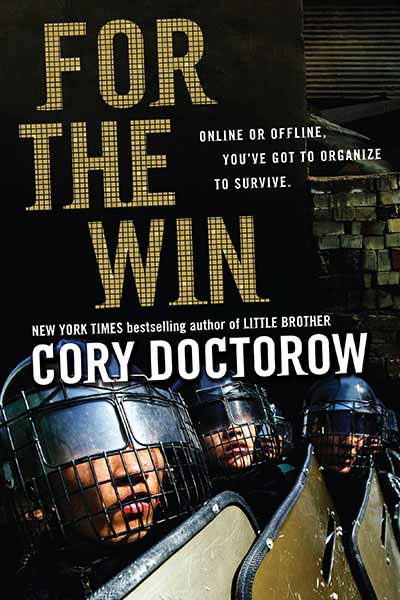
Tim “Undercover Economist” Harford’s feature with FiveBooks lists five “unexpected economics” books, including my novel For the Win:

It is for young adults – it’s an adventure-action story, it’s not that complicated. But it’s very well done and conveys a lot of really interesting economic ideas very well. For instance there’s the impact of globalisation, the possibility of bubbles occurring in economic systems, the idea of the race to the bottom, of sweatshops and the role of unionisation. Really key economic ideas.

Of course there are a lot of economic ideas that are not in the book. I would also say that Cory is well to the left of where I am. He thinks trade unions are incredibly important – I’m not so sure. But I was very impressed by the way he could take this novel and convey all these economic ideas without slowing the action down. There have been people who have tried to create works of fiction with an economic message – notably Ayn Rand, who has just had a film made about her work – but Cory has really done it very well. It’s a tremendous and very admirable achievement.

/ / News

Tim “Undercover Economist” Harford’s feature with FiveBooks lists five “unexpected economics” books, including my novel For the Win:

It is for young adults – it’s an adventure-action story, it’s not that complicated. But it’s very well done and conveys a lot of really interesting economic ideas very well. For instance there’s the impact of globalisation, the possibility of bubbles occurring in economic systems, the idea of the race to the bottom, of sweatshops and the role of unionisation. Really key economic ideas.

Of course there are a lot of economic ideas that are not in the book. I would also say that Cory is well to the left of where I am. He thinks trade unions are incredibly important – I’m not so sure. But I was very impressed by the way he could take this novel and convey all these economic ideas without slowing the action down. There have been people who have tried to create works of fiction with an economic message – notably Ayn Rand, who has just had a film made about her work – but Cory has really done it very well. It’s a tremendous and very admirable achievement.

/ / News


I’m coming to Toronto in early June on my way to Personal Democracy Forum in New York; while I’m there, I’ll be speaking at the SubtleTechnologies event in Innis Town Hall at 6:30PM on June 4. I’m sitting on a panel called “How can we build a city that thinks like the web?” with Mark Surman (Mozilla) and Sara Diamond (OCAD), chaired by the CBC’s Dan Misener. The event is free, but pre-reg is required.

Can you remake a city in the image of the web? Can the open, decentralized, real-time spirit of the online world be applied to the places we live to make them more creative and innovative? What are the opportunities and challenges of the so-called “networked city?”

How can we build a city that thinks like the web?

/ / News

My new Guardian column, “My new Ubuntu-flavoured ThinkPad is computing heaven,” describes the miraculously drama-free life I’ve discovered by buying ThinkPads with extended warranties and running the Ubuntu flavor of GNU/Linux on them:

The problem with writing about switching to Ubuntu is that there’s very little to report on, because it is just about the least dramatic operating system I’ve used, especially when paired with the extended warranties Lenovo sells for its ThinkPads. By this I mean that Ubuntu, basically, just works as well as or better than any other OS I’ve ever used, and what’s more, it fails with incredible grace.

This graceful failure is wonderful stuff, and after a lifetime of using computers I’ve decided that it’s the thing I value most in my technology. Ubuntu is free – free as in beer, costing nothing; free as in speech, in that anyone can modify or improve it. That means that on those occasions where I’ve had a bad disk or some other problem, I could simply download a new copy of the OS, stick it on a USB drive and restart from the drive to troubleshoot and repair the OS. I don’t have to take a rescue disk on the road with me, don’t have to try to run out to the Apple store at 8:55PM to try to buy another copy of the OS before the shop closes. Anywhere I’ve got a working computer and an internet connection, I’ve got everything I need to fail gracefully.

My new Ubuntu-flavoured ThinkPad is computing heaven

/ / News

I’m taking a day off from writing next week to speak at the Open University and Oxford. On May 18, I’ll give a talk on technology, regulation and general-purpose computing at the OU in Milton Keynes and at the Oxford University Scientific Society. Both talks are open to the public. Here are the details for each one:

Open University:
Date/Time: 18 May 2011 at 2PM
Venue: Jenny Lee Room 1 (Ground Floor, entrance via balcony)
Seating is limited, so if you plan to attend please email Mary McMahon (M.McMahon@open.ac.uk) as soon as possible so we can advise you if there is sufficient space.

Oxford:
Wednesday, 18th May 2011, 8.15 PM
University of Oxford, Inorganic Chemistry Lecture Theatre, South Parks Road, Oxford OX1 3QR, UK
Talks are FREE for members and cost £2 for non-members. Refreshments will be served after the talk. Each lecture is followed by a reception with drinks, snacks, and the opportunity to talk to the speaker. If you would like to come to dinner with the speaker beforehand, please email the President (aguharoy@gmail.com) before 12 midday on the day of the talk.

/ / News, With a Little Help

ALA Booklist has posted a stonking review of With a Little Help:

Anyone who grooved to the counterculture vibe of Doctorow’s young-adult novels Little Brother (2008) and For the Win (2010) will embrace these stories heartily—no one can dole out technological cautionary tales while simultaneously celebrating technology as cunningly as Doctorow. This volume’s single never-before-published story, “Epoch,” is the standout, an ethically thorny but heartfelt update on the classic sf conceit of an AI that becomes too self-aware. Never one to avoid the jugular, Doctorow doesn’t bother to assign Google an alias in “Scroogled”; the depiction of a world where we’re all “Googlestalked” until we’re “guilty of something” feels chillingly immediate. It’s not always easy to warm up to Doctorow’s purposeful characters, but it’s easy to be swept up in their just-barely-futuristic travails of surveillance gone wrong and privacy shattered. Reading this on your iPhone? Then these stories are probably for you.

/ / News

ALA Booklist has posted a stonking review of With a Little Help:

Anyone who grooved to the counterculture vibe of Doctorow’s young-adult novels Little Brother (2008) and For the Win (2010) will embrace these stories heartily—no one can dole out technological cautionary tales while simultaneously celebrating technology as cunningly as Doctorow. This volume’s single never-before-published story, “Epoch,” is the standout, an ethically thorny but heartfelt update on the classic sf conceit of an AI that becomes too self-aware. Never one to avoid the jugular, Doctorow doesn’t bother to assign Google an alias in “Scroogled”; the depiction of a world where we’re all “Googlestalked” until we’re “guilty of something” feels chillingly immediate. It’s not always easy to warm up to Doctorow’s purposeful characters, but it’s easy to be swept up in their just-barely-futuristic travails of surveillance gone wrong and privacy shattered. Reading this on your iPhone? Then these stories are probably for you.

/ / News, Podcast

I have a short story called “Shannon’s Law” in the new Welcome to Bordertown anthology, the first Bordertown book in decades. I was absolutely delighted to be invited to contribute a story, and had a fun time writing my piece, which is about the application of information theory to the problem of bridging the lands of Faerie with the mundane world. Escape Pod will be podcasting the story shortly as well:


The Net’s secret weapon is that it doesn’t care what kind of medium it runs over. It wants to send a packet from A to B, and if parts of the route travel by pigeon, flashing mirrors, or scraps of paper cranked over an alleyway on a clothesline, that’s okay with the Net. All that stuff is slower than firing a laser down a piece of fiber-optic, but it gets the job done.

At BINGO, we do all of the above, whatever it takes to drop a node in where a customer will pay for it. Our tendrils wend their way out into the Borderlands. At the extreme edge, I’ve got a manticore trapper on contract to peer into the eyepiece of a fey telescope every evening for an hour. He’s the relay for a kitchen witch near Gryphon Park whose privy has some magick entanglement with the hill where he sits. When we can’t get traffic over Danceland in Soho because the spellboxes that run the amps and the beer fridges are fritzing out our routers, our kitchen witch begins to make mystic passes over her toilet, which show up as purple splotches through the trapper’s eyepiece. He transcribes these—round splotches are zeroes, triangular splotches are ones—in 8-bit bytes, calculates their checksum manually, and sends it back to the witch by means of a spelled lanthorn that he operates with a telegraph key affixed to it with the braided hair of a halfie virgin (Tikigod’s little sister, to be precise). The kitchen witch confirms the checksum, and then he sends it to another relay near the Promenade, where a wharf rat who has been paid handsomely to lay off the river water for the night counts the number of times a tame cricket sings and hits a key on a peecee in time with it. The peecee pops those packets back into the Net, where they are swirled and minced and diced and routed and transformed into coffee, purchase orders, dirty texts, desperate pleas from parents to runaways to come home, desperate pleas from runaways to their parents to send money, and a million Facebook status updates.

Mostly, this stuff runs. On average. I mean, in particular, it’s always falling apart for some reason or another. Watch me knock some heads and you’ll get the picture.

The heliographer’s tower is high atop The Dancing Ferret. Everyone told me that if Farrel Din could be persuaded to get involved with BINGO, all of Soho would follow, so I did some homework, spread some money around, and then I showed up one day with a wheelbarrow filled with clothbound books that I’d had run up by the kids who put out Stick Wizard.

Shannon’s Law

Update: The Escape Pod podcast is live! (here’s the MP3)