/ / News, Podcast


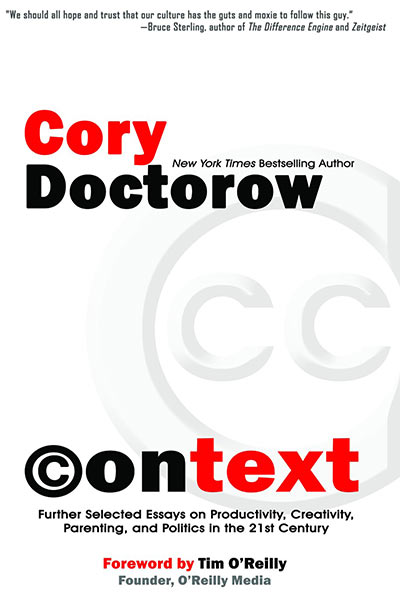
Here’s a reading of my essay Jack and the Internetstalk, just reprinted in my second essay collection Context: Further Selected Essays on Productivity, Creativity, Parenting, and Politics in the 21st Century.

Mastering by John Taylor Williams: wryneckstudio@gmail.com

John Taylor Williams is a full-time self-employed audio engineer, producer, composer, and sound designer. In his free time, he makes beer, jewelry, odd musical instruments and furniture. He likes to meditate, to read and to cook.

MP3 link

/ / News

Context: Further Selected Essays on Productivity, Creativity, Parenting, and Politics in the 21st Century, my second essay collection, is now officially available from Tachyon Books, and in finer bookstores everywhere. It features an introduction by the estimable Tim O’Reilly, as well as a walloping 44 essays that were previously published in various magazines, newspapers and websites. As with my other books, the whole text is available as a Creative Commons BY-NC-SA download for your remixing pleasure. I’m also in search of libraries and school that would like free copies of the book sent to them by donors.

From Tim’s introduction:


Edwin Schlossberg once said “The skill of writing is to create a context in which other people can think.” And oh, how we need that skill today!

In times of transition and upheaval, we are literally “off the map” of past experience that is our normal guide to what to expect and how to think about it. It’s at times like these that we need context-setters to shape how we understand and think about the changes facing us.

It was clear from the first that Cory Doctorow is one of the great context-setters of our generation, helping us all to understand the implications of the technology being unleashed around us. We are fortunate that unlike many who practice this trade, who look backward
at recent changes, or forward only a year or two, Cory uses the power of story to frame what is going on in larger terms.

Context: Further Selected Essays on Productivity, Creativity, Parenting, and Politics in the 21st Century

/ / Monthly Financials, News, With a Little Help

All time:
Income: $42,033.95
Outgo: $24,887.49

Net: $17,146.46


This reporting period:
Income: $2,231.23

  • Special editions: $550.00 (all time $18,148.00)
  • Lulu Paperbacks: $48.14 (all time $709.25)
  • Amazon Paperbacks: $174.65 (all time $303.29)
  • CDs: $0.00 (all time $54)
  • Donations (43 donors): $568.44 (all time $2,791.17)
  • Columns: $800.00 (all time $10,000.00)
  • Print on Demand bookstore sales: $90.00 (all time $90.00)

Expenses: $167.88
Special editions: $93.00(all time $13,551.19)

  • Special edition postage: $93.00

All editions: $40.00 (all time $4,734.88)

  • LightningSource fees: $40.00

Donations:$34.88 (all time $188.31)

  • Paypal fees: $34.88

Sales:

Hardcovers: 2 (all time 77)
Paperback (Leider cover): 10 (all time 50)
Paperback (Rucker cover): 2 (all time 38)
Paperback (Wu cover): 7 (all time 50)
Paperback (Defendini cover): 126 (all time 224)
MP3 CDs: 0 (all time 16)
Ogg CDs: 0 (all time 7)


Inventory:

  • 7 hardcovers
  • 50 review paperbacks
  • 50 review boxes
  • 50 review postage
  • 10 paperbacks

/ / News, Podcast

Here’s a reading of my short story Brave Little Toaster, which was just published in TRSF, the inaugural science fiction anthology from MIT’s Tech Review. It’s a short-short story on the “Internet of Things” and what happens when it all goes wrong.

Mastering by John Taylor Williams: wryneckstudio@gmail.com

John Taylor Williams is a full-time self-employed audio engineer, producer, composer, and sound designer. In his free time, he makes beer, jewelry, odd musical instruments and furniture. He likes to meditate, to read and to cook.

MP3 Link

/ / News

Here’s the video from the talk I gave last week at the O’Reilly Strata conference on “big data” in NYC. The talk is called “Designing for Human Sensors, Not Human Barcodes,” and it talks about the philosophy underpinning the “privacy bargain” we strike online when we trade personal information for access to services.

Strata Summit 2011: Cory Doctorow, “Designing for Human Sensors, Not Human Barcodes”

/ / News

Earlier this week, I gave a talk on the way that “Big Data” is underpinned with a kind of myth about how users trade privacy for services. Ciara Byrne from the NYT’s VentureBeat interviewed me afterwards about it. I think she did a really good job of condensing a hard, nuanced question into a brief and informative article.

/ / News

TRSF is a new science fiction anthology of original stories commissioned by Technology Review, the tech magazine published by MIT. They commissioned a story from me, “The Brave Little Toaster,” and the brief asked me to look at near future science and technology issues — I tackled “The Internet of Things,” and told a story about a man whose refrigerator ends up hosting an unfortunate (very unfortunate!) Internet of Things object. The book is $7.95 for pre-order.


Featuring all-new stories by a dozen of the most visionary science fiction authors writing today, TRSF takes us to 12 possible worlds of tomorrow. Inspired by the real-life breakthroughs covered by MIT’s Technology Review, celebrated writers join the freshest talent from around the world to describe what the future may have in store for the Internet, biotechnology, energy, computing, and more.

Illustrated with an original cover painting by legendary sci-fi illustrator Chris Foss, the TRSF also features classic Foss covers inside its pages.

Order Today: TRSF, a Technology Review Special Publication

/ / News

My latest Guardian column, “Lib Dems get a chance to vote on copyright reform,” discusses the new Liberal Democrat IT white paper that’s being presented at the party conference this weekend, where members will get the chance to vote in favor of repealing some of the worst sections of the Digital Economy Act, dealing with web-censorship and disconnection over copyright claims. The paper is very good, but somewhere between the final draft prepared by the committee and the paper the membership will vote on this weekend, someone inserted a clause saying that “a form of theft” and goes on to say that “there is no reason why digital offenders should not be prosecuted under the criminal law in the same way as those who steal tangible goods.” I’ve spent the past few days trying to track down who put this language in, and everyone both denies it and says they don’t support it — which raises the question, what’s it doing there at all?

This is pretty outre stuff. Every developed nation’s legal system treats thefts of tangible goods as absolutely distinct from copyright violation. Applying criminal sanctions for copyright infringement would be unprecedented in the industrialised world.

Don Foster, the Lib Dem MP with the DCMS brief, apparently lobbied to have “a statement making clear that copyright infringement is as serious as theft” included in the document, though his staff disavows any involvement in the phrasing and says: “For Don, non-commercial copyright infringement has only ever been a civil issue.” Julian Huppert, the Lib Dem MP who was also involved in the drafting, says, “there is no intention to change the current system in this regard”.

Lib Dems get a chance to vote on copyright reform