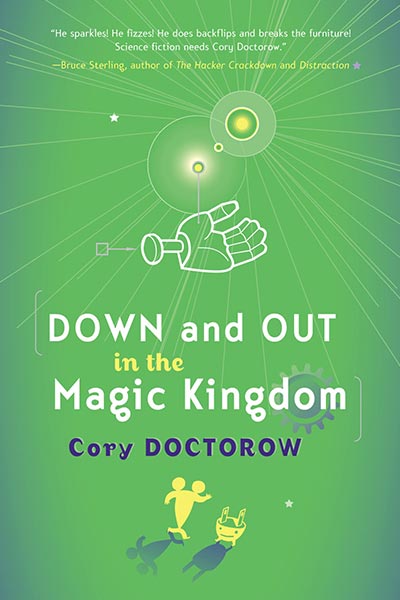
NewsBooklistWelcome to Bitchun society, where all today's commonplace problems have been solved: even death is a minor inconvenience, since one can make regular backups. Our hero has gone to Disneyland--his habit at times of major personal crisis--where he works for the ad-hocracy that runs the Haunted Mansion and the Hall of Presidents. It is a great honor to be working on the pinnacle of late-twentieth-century cultural and artistic achievement--Disneyland, that would be--and it inspires great loyalty. Our man begins feeling the pressure of change, however, after a cookie-cutter teenybopper shoots him dead for apparently no reason at all. Convinced that a new ad-hocracy on the block used his death to take over the Hall of Presidents, he vows to sabotage their plans and protect the sanctity of the Haunted Mansion. Thus begins a cycle of destruction and conflict with unexpected ramifications for the park--and his personal life. An excellent ride, entertaining and unpredictable. Entertainment WeeklyWhat better place to fantasize about our troubling evolutionary path than Tomorrowland? Doctorow takes the scariest scientific advances -- cloning, medical immortality, an inter-networked world in which social standing is based on eBay-style ratings -- and sets them inside a Disney theme park. More specifically, these techno-possibilities are the backdrop for a battle over the Haunted Mansion. Members of the governing "Ad-hocracy" want to preserve the attraction's animatronic innards, but a techno-populist team from Disneyland Beijing has developed a way to flash-bake experiences directly on visitors' brains. The resulting tug-of-war leads to on-line insurrections, fan-led coups, and an assassination. The futuristic roller-coaster that is Down and Out travels is more fascinating than the murder-mystery at its core. Still, Doctorow's debut is a sci-fi ride worth lining up for. A- Great interview on O’Reilly NetworkRichard Koman has posted a long, wide-ranging interview with me on the O'Reilly Network, mostly about the book, but very wide-ranging, covering the future and past of the recording industry, the history of the Disney corporation, power-law distributions and such.
The OnionFew science-fiction tropes have been done to death so thoroughly as the image of the future as an ultra-high-tech playground, in which human bodies are mutable, death is a temporary inconvenience, and the only remaining social problem is boredom. At its bleeding edge, America is halfway there already; it doesn't take a great deal of imagination to draw present technology out to a blue-sky conclusion. The imagination comes in predicting how technological evolution will change humanity, and in building a believable world that makes the future worth visiting. Cory Doctorow's first novel, Down And Out In The Magic Kingdom, borrows freely from tropes established by pioneers like John Varley, Spider Robinson, and Robert Silverberg, and refined more recently by the likes of William Gibson, Neal Stephenson, and Rudy Rucker. But Kingdom establishes its individuality with smooth and practiced ease, drawing out a kinetic, immersive yarn that seems far more detailed than its scant 200 pages should permit. In Kingdom, "free energy" and scientific advances have rendered scarcity and poverty extinct. Near-universal computer networking has created a meritocracy which replaces money with "Whuffie," a constantly shifting measure of societal esteem. As networked people interact, their computer implants tabulate their respect or contempt for each other; well-regarded individuals receive all the privileges of old-style wealth and fame, while unpopular people become pariahs, granted only the basics in food and shelter. Doctorow establishes his background in a few broad strokes before digging into the meat of his story: a series of machinations between two Whuffie-hungry groups vying for power in Disney World. Like everyone else in Doctorow's capricious "ad-hocracy," entertainers live by their popularity: By creating a successful and beloved theme ride, a group can bolster its reputation and gain power for its next social coup. Kingdom's first-person narrator, Jules--a rejuvenated centenarian with the body of a 40-year-old and a fond fascination for Disney World--leads the charge to maintain the charm of the Haunted Mansion, preserving it from the neophilic organization replacing the Hall Of Presidents' charming animatronics with virtual simulations and cortical downloads. Their battle is fought half in engineering, where new designs and plans are created, and half in the public eye and on the public net, where they struggle for the popular backing that will keep their rivals at bay. To Doctorow's credit, their tiny war is as fascinating as it would be if it concerned a matter of actual importance. Kingdom expertly blends the peer-rating mania of current net-entities, from Slashdot to eBay, with current corporate strategies, hiding it all behind a colorful futuristic façade. Meanwhile, Jules puts a personal face on an impersonal world, as he struggles with technological failures, a suicidal friend, a painful love triangle, and an unknown rival who casually, publicly murders him. The result is a moderately prescient, wholly entertaining yarn that's short enough to be read in a single sitting, and involving enough that it almost inevitably will be. Potlatch in San FranciscoI'm attending Potlatch, the excellent literary science fiction convention in San Francisco. I'll be running a panel on "Smart Mobs and the Civil Polity," and I'll be doing a reading, back to back with Rudy Rucker, at 6PM on Saturday, February 22nd. Hope to see you there! SFWeeklyDoctorow aligns himself right from the get-go with an axis of serious jocularity, whose members are such folks as Rudy Rucker, Robert Sheckley, Matt Ruff, Jonathan Lethem and, at his loosest, Bruce Sterling. These authors spin off wild blue-sky ideas in rigorous profusion, as many as any recognizable hard SF author, but couch them in absurdist plots populated by eccentrics and oddballs. (It's interesting, for instance, to compare Doctorow's book with John Wright's The Golden Age [2002]), which deals with many of the same issues of posthuman living, but ! in a sober, leaden tone.) Life is not to be taken too seriously in the works of these writers, and Doctorow has come up with a great objective correlative to this attitude, in the ability of his protagonists to spring back even from explosive bodily destruction, like Wile E. Coyote. (The downloading-into-clones motif was definitively established by John Varley 30 years ago, but even he did not employ it so blithely.) In any case, what we have here is a rare example of post-Singularity fiction. The Singularity, or Spike, is deemed to be that moment at which mankind emerges into transhuman existence, with or without the help or hindrance of strong AI. (Doctorow eschews the AI, for the most part.) Envisioning such a future is one of the hardest tasks an SF writer can take on, but Doctorow proves himself equal to the challenge. His reorganization of society into ad-hocs craving Whuffie derives a lot from present-day cyber-culture (Slashdot, and all that), and his biomorphic mutability seems positively Extropian. But the exact mix is unique, especially when the fixation on Disney World as a kind of prototype for artificial landscapes is thrown in. And surely Jules' jazzy first-person narration, laden with future jargon, is essential to the success of the tale. Although readers might initially balk a bit when encountering on the second page of the book a sentence such as "I took! a moment to conjure a HUD with his Whuffie score on it." Di Filippo reviews Down and OutOne of my favorite authors, Paul Di Filippo, reviews Down and Out in the Magic Kingdom in this week's SF Weekly:
Extropian radio interviewLast week, I did an interview with Changesurfer Radio, an extropian radio program. There's MP3 of the interview online. TrashotronBut operating beneath this glossy, enjoyable surface is a very complicated world filled with intelligently conceived advances and retreats. From the contents of a 208 page book, one could excavate more than a few doctoral theses on various aspects of Doctorow's Bitchun Society. For current computer geeks, Doctorow sprinkles his prose with just the right number of Unix-derived terms. For sociologists, Doctorow has constructed a fascinating society where the currency is the respect you receive from those who know you. For futurists, Doctorow has offered up a gleaming utopian vision utterly unlike those of other cyberpunk authors. For anybody who has ever had to backup or restore their computer's files, he offers heaven itself. For all the simplicity and limpidity of the narrative, there's a very complex stew of ideas bubbling just underneath Doctorow's sunny story. 'Down and Out In the Magic Kingdom' is a novel of ideas. It shares more in common with the work of Stanislaw Lem than with William Gibson. Cheap laughs and deep thoughts jostle one another, having a swell time as the reader enjoys the painful revelations that await Jules. Doctorow covers a lot of conceptual ground in a small space, and he makes something that's rather complex look ridiculously easy. But don't try this at home kids. You may injure your brain. If you're not backed up, then you might not be able to recover. We may think we're bitchin' -- but we're not Bitchun yet, not by a long shot. SFRevuAfter you've beaten death, disease and poverty where do you go to while away the hours? What can you do to fill up the value void left in the wake of abandoned humanism? Cory Doctorow, a brilliant Canadian short story author with plenty of promise, sets forth his own answer in his first novel, Down and Out in the Magic Kindgdom. You go to Disneyworld. Brighter minds than mine will probably see Disneyworld as a metaphor for post-human reality. It's a classic example of a group of humans finding meaning in going through the motions. Is the charade of characters and guests at mouseland any less real than the charade of walking around being "yourself"? When we've opted for backups of our experiences that can be loaded into fast grown clones, when whatever you want can be poured out of a faucet for the asking, what's left that we can find meaning in? |
Doctorow’s success must confuse the extremist wing of modern publishing, which constantly tells us how copies of works online are strangling new artists in the crib, while wrapping its own e-books and CDs in endless layers of copy protection.
[Read more quotes about the book] [FAQ] [Get a signed copy shipped to your door] ![]() Paperback ISBN: 076530953X
|
|||
|
Down and Out In the Magic Kingdom is proudly powered by
WordPress
|
||||