NewsFrequently Asked Questions, Part 1Some answers to frequently asked questions: Q: Where does the word Whuffie come from? A: It's just a made-up word we used interchangably with "Brownie Points" in high-school. Some people have suggested that it might have come from the Arsenio Hall show's "woof woof woof" noises. Q: Did you know that Amazon lists the publication date for your book as December 31, 1969? A: Yes. Wish I could do something about it, too. Q: Can't I just send some money to you by PayPal instead of buying the book? A: You don't have to buy the book, but I'm not interested in tipjar payments. I'm not doing this to compete with my publisher. If you read the ebook and want to pay me back, but don't have any use for the dead-tree edition, the best way you can do that is to buy a copy of the book and donate it to a school, library or community center. If you do this, you'll put a copy of the book on the shelf where it might be read, I'll get a royalty, and my sales-figures will go up (which means that I'll get a bigger advance on my next book and my publisher will be more likely to want to repeat the experiment). 17 Responses to “Frequently Asked Questions, Part 1”Leave a Reply |
The book is designed simply, with key relationships being established with an economy of words that leads to a reading experience that I found immensely refreshing, accomplishing in approximately two hundred pages what other novels take four hundred to do. I must be becoming used to reading doorstops as the mid-point climax hit me like the slap of an enraged fat woman, unexpected and full of reverberation.
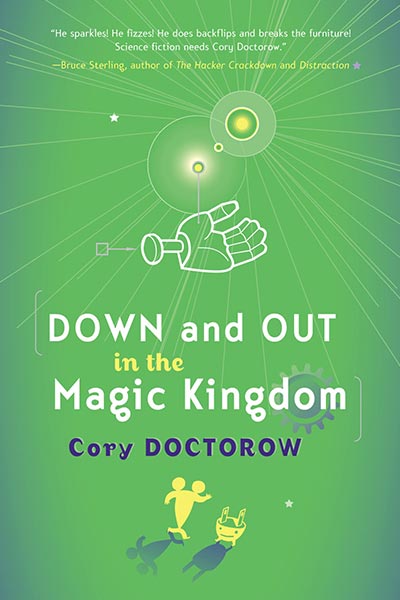
[Read more quotes about the book] [FAQ] [Get a signed copy shipped to your door] ![]() Paperback ISBN: 076530953X
|
|||
|
Down and Out In the Magic Kingdom is proudly powered by
WordPress
|
||||
Unfortunately, and utterly wrong-headedly, many libraries these days don't actually take donated books anymore—for their shelves, anyway; they usually end up in book sales.
Here's my advice for what to do with the book if you don't want it: go to http://www.bookcrossing.com , slap a label on it, and set it free!
Oddly enough, I also noticed that William Gibson's new book, "Pattern Recognition" is also listed as being released on Dec 31, 1969.
Stupid Amazon, I ordered "Down And Out..." a week ago and it won't ship until February 4. Barnes and Noble has it stocked and is shipping within 2-3 days.
B-b-but...
Everybody knows that time began 00:00:00 GMT, January 1, 1970!
Maybe you'll find this interesting. Nowadays in Russia, the majority of scifi publishers and authors release books electronically as well as on paper. There are huge online libraries with Russian-language scifi and other works, all completely legal. The only difference is that they usually release a book electronically some time after it's launched on paper (usually in a few months), so the publisher can get good revenue from sales in the first hot months and the author can still reach the widest possible audience. (Many Russians live abroad, and for them it's not easy or cheap to get books from Moscow publishers.) So for most authors, all of their books except for the most recent title can be downloaded for free. I'm glad to see this model is starting to be used in the English speaking world, but I'd suggest that you also consider using a time gap between paper and electronic releases. I think this will make the scheme more viable commercially, so that not only top ten authors can use it (and still make profit) but the hordes of less-successful writers as well. We need much more than one great release for this publishing scheme to become norm rather than a curiosity.
What about your publisher taking contributions? I'd be interested in donating the amount that's ultimately cleared on a dead tree paperback.
I read the book on my Palm Pilot on the subway over the past week and really enjoyed it.
Well, there *is* no paperback edition, but that aside, the cost of bookeeping an entirely new type of transaction (which would also include the cost of my agent and my publisher's lawyers negotiating how to handle this kind of transaction) would far exceed that kind of sum -- IOW, they'd save money if they tore up your check.
My friends and I are curious about how the experiment is going with the Creative Commons licence. Are sales good? Is there somewhere we can go to look this kind of thing up?
Publishing is *really slow*, so it takes about a year to find out how a book really sells (publishers don't sell books to stores and distributors -- they consign them, so until the returns come back, all you know is how well the book has shipped, not how well it sold).
That said, all signs -- Booksense rank, Amazon rank, copies shipped -- point to this book selling fantastically well.
Funny, when I was backforming "Whuffie" in my head, I kept coming up with acronyms: WFI or WFE. "World Favourites Index", for instance. Or "Well-Favouredness Index". Nothing satisfactory yet, though. It bothered me vaguely that the term's origin was non-obvious and yet never ever alluded to in the book. To find out it's a high-school in-joke is a bit of a disappointment.
I'm curious, I know you don't have a tip jar, but would your publisher allow you to have one?
I spect they might -- I've never asked!
Isn't it true that 'Down and Out' was 1st pubbed online, and only afterwards picked up by a dead-tree publisher? Or is that just a rumor?
Can someone explain the words that don't have a meaning in today's vocabulary? I mean, what is an ad-hoc? And a cochlea? And a Whuffie (definition, not origin)?
Joe:
ad-hoc is a latin phrase meaning "for this [purpose]" check out http://en.wikipedia.org/wiki/Ad_hoc for more info.
The cochlea is a part of the inner ear, that turns sound into nerve impulses.
Whuffie is a term Cory made up, somewhat analogous to a currency based on reputation.
http://en.wikipedia.org/wiki/Whuffie
I'm still quite curious about the sales at this point. Comment 8 addresses this but is currently quite dated. In the years retrospect what have sales been like. Perhaps some tangible numbers would be available at this point? I address ideas of property rights and profit quite often and this would be another excellent example.
What was the inspiration to "Down and Out in the Magic Kingdom"? In the future we could do anything, how ever Cory has decided to use Disney World. Did the urban legend of Walt Disney's cryogenic freezing help inspire this book, and why did we not bring Disney back in the book?
Пробуйте, попытайтесь))