I’ve got a old-fashioned link-blog, Pluralistic, where I post a daily list of links with commentary and analysis. If you’d prefer to get it as a newsletter, you can subscribe to the Plura-list. Both are free from surveillance and advertising.

This week on my podcast, I read Not Normal, my latest Locus Magazine column, about the surreal and terrible world we’ve been eased into thanks to anti-circumvention laws.
If you were paying attention in 1998, you could see what was coming. Computers were getting much cheaper, and much smaller. From cars to toasters, from speakers to TVs, we were shoveling them into our devices. and an it doesn’t take a lot of expense or engineering to add an “access control” to any of those computers.That meant that DMCA 1201 was about to metastasize. Once you put a computer into a thermostat or a bassinet or a stovetop or a hearing aid, you can add an access control and make it a felony to use it in ways the manufacturer disprefers. You can make it illegal to use cheap batteries, or a different app store. You can add little chips to parts – everything from a fuel pump to a touchscreen – and make it illegal to manufacture a working generic part, because the generic part has to bypass the “access control” in the device that checks to see whether it’s the manufacturer’s own part.

This week on my podcast, I read All laws are local a recent post from my Pluralistic.net blog, about the ephemerality of our seeming eternal verities.
In other words, things that seem eternal and innate to the human condition to you are apt to have been invented ten minutes before you started to notice the world around you and might seem utterly alien to your children. As Douglas Adams put it:Anything that is in the world when you’re born is normal and ordinary and is just a natural part of the way the world works. Anything that’s invented between when you’re fifteen and thirty-five is new and exciting and revolutionary and you can probably get a career in it. Anything invented after you’re thirty-five is against the natural order of things.

This week on my podcast, I read “Threads’ margin is the Eurostack’s opportunity,” a recent post from my Pluralistic.net blog, about the tactics that digital sovereignty advocates can deploy to counter Meta’s (further) enshittification of Threads.
The funny thing is, the OG App creators were just following the Facebook playbook. When Facebook opened up to the general public in 2006, it had the problem that everyone who wanted social media already had an account on Myspace, and all of Facebook’s improvements on Myspace (Zuck made a promise never to spy on his users!) didn’t matter, because Myspace had something Facebook could not match: Myspace had all your friends.Facebook came up with an ingenious solution to this problem: they offered Myspace users a bot. You gave that bot your Myspace login credentials (just as OG App did with your Insta credentials) and the bot impersonated you to Myspace (just as OG App did with Insta), and it grabbed everything queued up for you on Myspace (just as OG App did with Insta), and then flowed those messages into your Facebook feed (just as OG App did with Insta).

This week on my podcast, I read “Code is a liability (not an asset),” a recent post from my Pluralistic.net blog, about the bad ideas behind the drive to replace programmers with chatbots.
Code is a liability. Code’s capabilities are assets. The goal of a tech shop is to have code whose capabilities generate more revenue than the costs associated with keeping that code running. For a long time, firms have nurtured a false belief that code costs less to run over time: after an initial shakedown period in which the bugs in the code are found and addressed, code ceases to need meaningful maintenance. After all, code is a machine without moving parts – it does not wear out; it doesn’t even wear down.

This week on my podcast, I play the audio from (Digital) Elbows Up: How Canada Can Become a Nation of Jailbreakers, Reclaim Our Digital Sovereignty, Win the Trade-War, and Disenshittify Our Technology, a speech I delivered on November 27, 2025 at OCADU in Toronto, Canada (video here, transcript here).
I recognize that this is all very abstract, so let me make it concrete. When you buy a printer from HP, it becomes your property. What’s property? Well, let’s use the standard definition that every law student learns in first year property law, from Sir William Blackstone’s 1753 treatise:
“Property: that sole and despotic dominion which one man claims and exercises over the external things of the world, in total exclusion of the right of any other individual in the universe.”
The printer is yours. It’s your property. You have sole and despotic dominion over it in exclusion of any other individual in the universe.
But HP printers ship with a program that checks to see whether you’re using HP ink, and if it suspects that you’ve bought generic ink, the printer refuses to use it. Now, Congress never passed a law saying “If you buy an HP printer, you have to buy HP ink, too.” That would be a weird law, given the whole sole-and-despotic dominion thing.
But because HP puts an “access control” in the ink-checking code, they can conjure up a brand new law: a law that effectively requires you to use HP ink.
Anticircumvention is a way for legislatures to outsource law-making to corporations. Once a corporation adds an access control to its product, they can create a new felony for using it in ways that benefit you at the expense of the company’s shareholders.

This week on my podcast, I play the audio from A post-American, enshittification-resistant internet, a speech I delivered on December 28, 2025 at 39C3, the Chaos Communications Congress in Hamburg, Germany (video here, transcript here).
Trump has staged an unscheduled, midair rapid disassembly of the global system of trade. Ironically, it is this system that prevented all of America’s trading partners from disenshittifying their internet: the US trade representative threatened the world with tariffs unless they passed laws that criminalized reverse-engineering and modding. By banning “adversarial interoperability,” America handcuffed the world’s technologists, banning them from creating the mods, hacks, alt clients, scrapers, and other tools needed to liberate their neighbours from the enshittificatory predations of the ketamine-addled zuckermuskian tyrants of US Big Tech. Well, when life gives you SARS, you make sarsaparilla. The Trump tariffs are here, and it’s time to pick the locks on the those handcuffs and set the world’s hackers loose on Big Tech. Happy Liberation Day, everyone!Enshittification wasn’t an accident. It also wasn’t inevitable. This isn’t the iron laws of economics at work, nor is it the great forces of history.
Enshittification was a choice: named individuals, in living memory, enacted policies that created the enshittogenic environment. They created a world that encouraged tech companies to merge to monopoly, transforming the internet into “five giant websites, each filled with screenshots of the other four.” They let these monopolists rip us off and spy on us.
And they banned us from fighting back, claiming that anyone who modified a technology without permission from its maker was a pirate (or worse, a terrorist). They created a system of “felony contempt of business-model,” where it’s literally a crime to change how your own devices work. They declared war on the general-purpose computer and demanded a computer that would do what the manufacturer told it to do (even if the owner of the computer didn’t want that).
We are at a turning point in the decades-long war on general-purpose computing. Geopolitics are up for grabs. The future is ours to seize.
In my 24 years with EFF, I have seen many strange moments, but never one quite like this. There’s plenty of terrifying things going on right now, but there’s also a massive, amazing, incredibly opportunity to seize the means of computation.
Let’s take it.

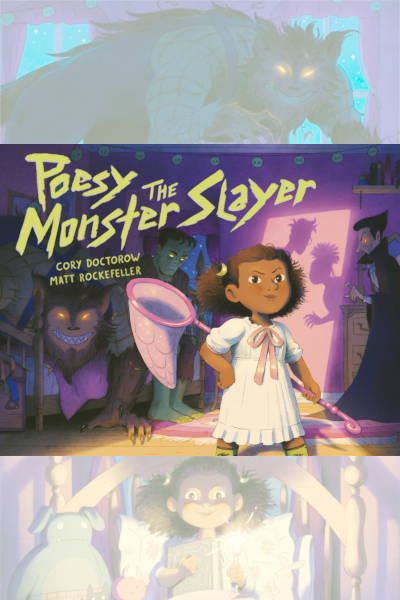
This week on my podcast, I sit down with my daughter Poesy, for our annual Daddy-Daughter Podcast, a tradition we’ve had since she was three (she’s 17 now!). This year, Poe recaps her graduation, her triumphs with her dance team, and her life at college! She offers us a tutorial on playing Egyptian War, and we sing Jingle Bells!

This week on my podcast, I read my latest Locus Magazine column, “Show Me the Incentive, I’ll Show You the Outcome,” about the process by which we ended up with an enshittogenic policy environment:
The whole point of the conservative project is to take away choices, and corral us into “preferences” that we disprefer. Eliminate no-fault divorce, suppress the vote, gerrymander the electoral map, cram a binding arbitration clause into every terms of service and a noncompete into every labor contract, buy up all your competitors, DRM-lock all the media, ban contraception and abortion, and you’ve got a world of partners you can’t divorce, politicians you can’t vote out, companies you can’t sue, jobs you can’t quit, services you can’t leave, books and music you can’t move, and pregnancies you can’t prevent or terminate.
And after you are relentlessly corralled into all these things you hate, you will be told that you don’t hate them after all – because you revealed your preferences for them.
Consumerism is a terrible way to make change at the best of times, and it gets less effective by the day, as authoritarianism and market consolidation shrink the world of possibilities to an endless Pepsi Challenge, where “choice” is narrowed to which flavor of sweetened battery acid you hate the least.
I don’t think that end users are to blame for enshittification.

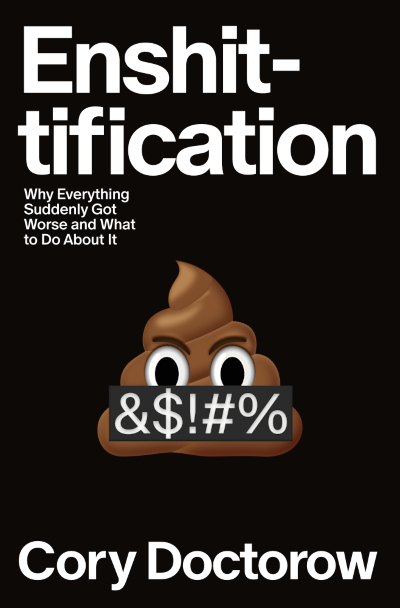
This week on my podcast, I’ve got the audio from last week’s Enshittification book-tour event with Ed Zitron and Whitney Betran at the Seattle Public Library (you can watch the video here). I’ve got many more cities to go on the tour – I hope to see you at one (or more) of them!

This week on my podcast, I’ve got the audio from last week’s Enshittification book-tour event with former FTC Chair Lina Khan at the Brooklyn Public Library (you can watch the video here). lI’ve got 24 more cities to go on the tour – I hope to see you at one (or more) of them!