/ / Makers, News

Each installment in Tor.com’s serialization of my latest novel Makers was accompanied by a Creative Commons licensed illustration from Idiots’ Books, in the form of a tile that can be interlocked with previous tiles on all four sides. We’re planning to release these as a limited-edition deck of cards in the future, and we’ve also been releasing little flashtoys that let you play with the tiles onscreen as they were released.

Now Tor has an embeddable version, courtesy of Malloc, which you can stick in your blog or wherever you choose! Here’s the code:

Makers Tile Game, now embeddable!

Review:

Barnes and Noble

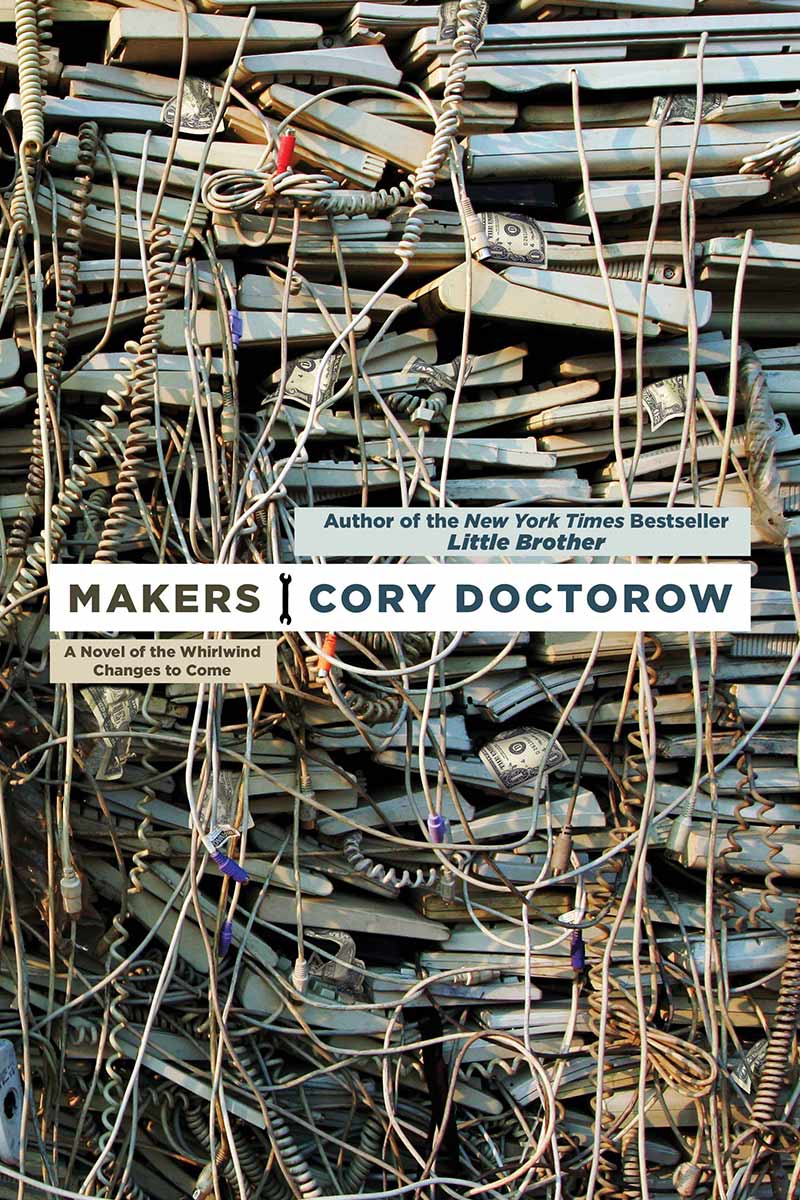
In the end, Makers feels like a personal, cultural, and literary milestone: an employment of the full literary toolbox of SF, in the service of a portrait of how the world actually works.

If only every genre author set out with the same high ambitions, there would be no talk of SF’s failures, only triumphs.

Paul Di Filippo, Barnes and Noble

/ / Makers, News

JC Hutchins — he of the boundless energy! — has assembled a free “holiday sampler” of excerpts from great new books, handily bundled together in a handsome PDF, well suited to loading onto your device or printing out for your Xmas holiday. In it are excerpts from recent books by some of my favorite authors, including Cherie Priest, Seth Godin, and Scott Sigler (as well as an excerpt from my latest novel, Makers.

In The Nick of Time holiday sampler (PDF)

JC’s page on the project with full contents and links

(Thanks, JC!

Review:

Michelle Pauli, the Guardian

Doctorow’s novel fizzes with ideas and jumps with breathtaking speed from one technological breakthrough to another until you’re no longer sure what’s based on reality and what’s purely a figment of his inventive mind.

Michelle Pauli, The Guardian

/ / Makers, News

The Guardian’s Michelle Pauli has written a stupendous profile of me and review of MAKERS for today’s edition:

In Makers, 3D printers are used to run off everything from homes for squatters to the fairground rides that cause the plot-twisting showdown with Disney. But, typically for a Doctorow novel, it’s not as far-fetched as it might sound: the 3D world is already here. He jumps up to show me a 3D museum object, part of a bear’s jaw, that was scanned and printed in six hours, and explains that he’s waiting for the post to bring one of the first 3D-printed objects he’s ordered online (“a beautiful big steel cross that looks like a nun’s cross except that the tips are screwdriver tips and it’s actually a multi-driver and it hangs around your neck from a leather thong!”) “We’ll have 3D printers which will make the world weird and they will beget something even weirder. 3D printers are just for starters!” he says, gleefully.

Despite his success in fiction – last year’s young adult novel Little Brother was a New York Times bestseller and he has previously won the Locus award and been nominated for Hugo and Nebula awards – Doctorow is better known in some quarters for his political activism around digital freedom and open rights. He’s the former European director of the Electronic Frontier Foundation, a civil liberties group that defends freedom in technology law, policy and standards; he co-founded the UK Open Rights Group; and he’s currently campaigning on the government’s draconian digital rights bill. Both sides of his work come together in his novels, not just in terms of subject matter but in the way they are distributed. Although published by mainstream presses, Doctorow also releases all his books for free download from his website under a creative commons licence, and talks enthusiastically about the uses people have made of these free online versions of his books, from foreign translations and student films to a teacher in a Detroit school for the blind who was able to run the download of Little Brother through the school’s Braille embosser for her students without having to painstakingly retype the whole book first.

Review:

Globe and Mail

Makers took me places I’d never been and would not have thought of visiting, and I had a wonderful time there. It introduced me to some really interesting strangers and involved me in their remarkable lives. It painted a persuasive picture of a better tomorrow I’ve been having more and more trouble imagining lately. And it was a lot of fun. It gives me renewed hope for the future, of both written science fiction and the world.

Spider Robinson The Globe and Mail